

Greetings! Today’s post will be about communication within game team, with the players—or customer, if we want to be business-oriented—, project management, and bit of marketing as well. We’ll come to notice that they’re all tied together and some of the same tools can be used to make all of them more efficient. I don’t do that much planning with these posts, so we’ll see where this rabbit hole takes. Exciting! You said it!
Making a game is all about communicating to the player, and—if you’re not a solo developer—with your team. You want the team to be making the same game as you and the customer to be buying the same game that you’re making. What I mean by that, is that if the the people in the team don’t understand what the game is trying to accomblish and if the player gets the wrong idea of what kind of game they’re buying, disappointments and false expectations are coming your way, big time. There are many obstacles and barriers between what’s in our heads and what gets through to other people, so let’s go over some of the things that make getting the point across easier.
Player Expectations
Let’s get right into it! When the player starts the game, it should be communicated early on what kind of world they’ve just stepped in. If you have comedy right at the beginning, the player will know to expect it later on. Have a super serious beginning and introduce comedy halfway through the game and it will feel out of place. The very beginning of the game should be like a mini version of the whole thing, or at least that’s what we’re going for. It makes sense that many game productions start from the middle part of the game so that when the beginning is made, it’s already clear what the core is and what makes it fun and/or interesting. We, in fact, didn’t start from the middle, but from the beginning of the game because we didn’t know of such practices when we began, but hey; you live and learn!
Of course, it all begins way before the player starts the game; maybe they’ve seen an ad or a friend told them of the game, then looked it up themselves, read a review or two, and eventually ended up on the Steam page, where they bought it. Many things can go wrong along the way. I have this A.I.D.A sales funnel saved in my Miro notes, which depicts these steps.

The big numbers there mean that from 500 000 people being aware of the game’s existence, 100 will end up buying it—generally speaking. Harsh, I know! I think I got these numbers from Chris Zukowski’s game-marketing lecture, but I’m not sure and too lazy to check again. The exact numbers are not the point here anyway, but to visualize thet steps the player takes before ending up buying the game.
If some of the these steps are misaligned or in conflict with each other, it creates those false expectations and disappointment we talked about earlier—and we don’t want that! In the following chapters, I’ll go over some of the steps we take to keep things in check.
Game Pillars
So—how do we keep the communication coherent through all those steps? First, we should establish game pillars for the project. They are parameters that limit and guide the process of design and production. In other words; they are fundamental concepts that the game wants to explore and be based on, and once stablished, they should be respected. Game pillars also help the team to understand how the project will be developed and be on the same page about what it’s trying to accomplish. Below are the pillars we’ve come up, when fleshing out the idea of Paradigm Island.
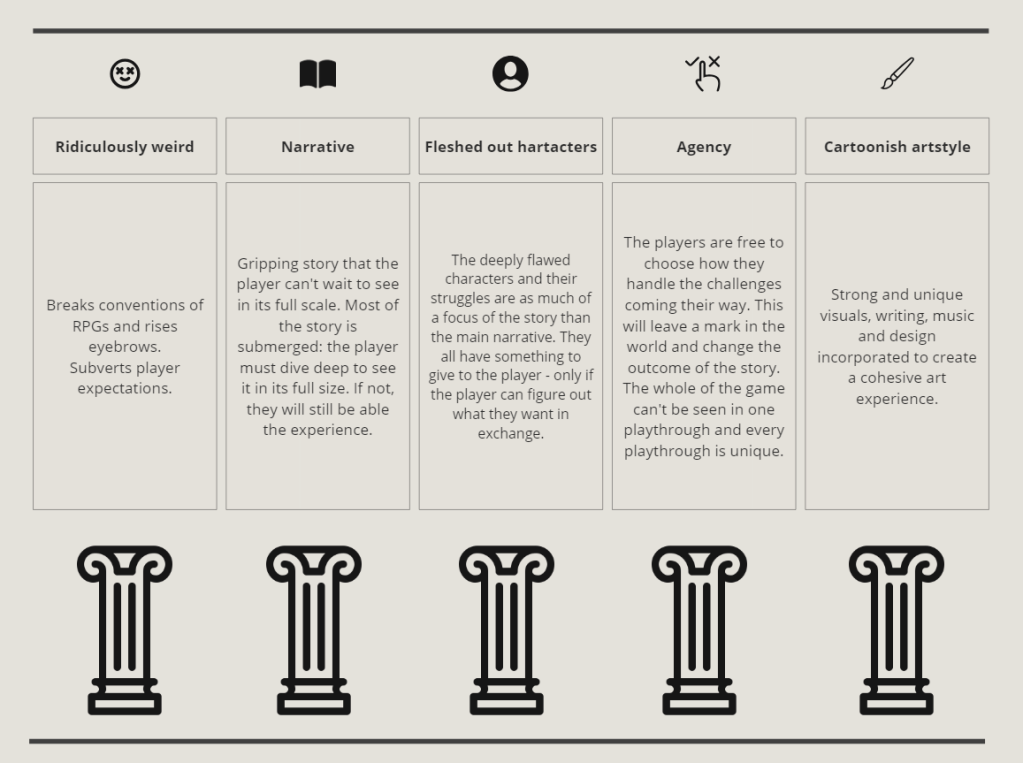
From time to time, it happens that a super awesome idea comes along, but doesn’t align with the established pillars. Then we will consider if it’s worth changing the pillars, and if so, the rest of the content will have to be checked to be sure that it goes along with the now changed new pillars. I’ve also made this flow chart to visualize the process of incorporating and weighing new ideas, or maybe I stole it from somewhere. Can’t remember.

Once the foundation is established, it’s much easier to make decisions and weight the consequences of possible changes on the scope of the production.
From the narrative point of view, the story’s theme should also be considered before getting too deep into the production, but that’s a topic for another blog post, since otherwise this one would get waaaay too drawn-out. Just keep that in mind, okay? We’re moving on!
Why?
How can we know if the point is coming across? The answer is, of course, testing. As soon as we have a feature in a somewhat playable condition, we should try to find someone new to the game to test it. It’s near impossible to know if something really works or not before we have someone—other than the people making the game—try it out. In our production, we try to follow a design loop like the one below. It’s much less organized than what’s depicted in the image, but we keep it in the back of our heads. The main takeaway from this could be that designing a feature shouldn’t be seen as a race where you make it and make it and eventually hit the goal when it’s ready, but rather as a loop that keeps repeating. I read a saying about game-making that went something like: “The game may be shipped, but it’s never ready”.

Once we have a feature that passes the filters listed earlier, we run it through this loop as many times as needed untill we feel like we succeeded with what we were trying to do with it. It’s worth noting that if an idea doesn’t catch on even after it has gone through this loop several times, it could be better to scrap it. More ambitious or original ideas would—of course—need more cycles than a basic quest system or something else time-tested like that. The core in the center stays the same and has to be understood by everyone in the team, and the game pillars make that much easier. It should also be considered why the feature is added; does it make the game more fun, make the message clearer, or add anything of substance? Making more content for content’s sake just adds unnecessary scope to the production and could even hurt the game’s core message.
Testing can also be used in marketing, for example, in what is called A/B testing. There we would make two versions of the same add—with different art or something like that—, push them out, and see which one produced more clicks, reactions or that sort of of thing. We could also run the same ads to two different target groups and test what kind of customer profile—which I’ll talk more about a later— responds best to our game. I won’t get too much into testing in terms of marketing; maybe it could also be a topic for a different blog post. Damn, it’s hard to not get sidetracked into oblivion when writing these posts!
Broken Telephone
In Paradigm Island, the story follows Mike, an orphan boy adopted by a group of mercenaries as an infant, now starting his first day on the job as a hired gun. Based on this knowledge, the player could expect there to be lots of shooting and combat involved. However, that’s not the case, and we try to make that point clear early on. One could argue that making a mostly non-violent game that follows soldiers is—well—a bad setup. There’s the danger of people looking for non-violent games skipping this one, once they learn that it involves mercenaries. Why even choose this kind of setup?
Gun violence in games is so common nowadays—and has been for a long time—that it doesn’t feel like anything anymore.
I’ve always been interested in the darker side of things and the people behind the evil that goes on in the world. Gun violence in games is so common nowadays—and has been for a long time—that it doesn’t feel like anything anymore. Nothing against gun violence—in games—, but we’re more interested to explore in our story, what goes inside someone’s head when committing such acts and the impacts it has on them and other people. That’s what this game is really about. CONSEQUENCES! That felt like a word that would sound funny shouted out loud.
To make a quick note on that violence thing: Paradigm Island is, without a doubt, a violent game; it just doesn’t depict it that much straight on, but deals more with the aftermath and threat of violence and the structural forms of it, practiced by corporations and governments, than the act itself. That’s enough for the challenges we face when communicating about our game, for now at least; let’s take a step back.
Finding our people
When making a trailer, Tiktok, or Youtube video, or any other form of ad for the game, it should already be very clear, what the core gameplay loop is and what the theme of the story and the genre of the game are. Making a game for everyone is impossible so we should know who the potential players for our game are.
Here we can do a bit of market research and investigate; what other games are similar to ours, what did and didn’t work with them, what kind of people generally play these kinds of games and what are those people’s interests.
Making customer profiles can help us narrow down who we should market our game to. With our game, Paradigm Island, being a text-heavy one, containing strong language and concepts for adults, we can exclude children altogether from the target audience. Laso; before we have access to the resources for localization (meaning translating the game to other languages), it wouldn’t make sense to market to countries where English is not the first- or generally fluently spoken language. Our game deals with social and environmental issues so one could also assume that a college student is more likely to have an interest in these topics than a middle-aged salesperson. These are all generalizations, of course, but we already have a better understanding of where to focus our resources, what kind of lingo to use in the marketing, and from which direction are we more likely to get a response. Below is an example of a customer profile of an ideal person to market our game to.

Final Thoughts
We would love to just focus on making the game and once it’s finished, release it to the players, brimming with excitement and eager to get their hands on it, but I’m afraid it isn’t quite as simple as that. Every month, thousands of games get released on Steam alone and if you want to get yours noticed, you’ll have to be prepared to scream your throat sore about why it’s the best thing out there. And not just scream, but scream smartly. You’re not competing with just other games either; all other forms of entertainment and activities are competing for the people’s attention just as much as games; should they watch Netflix, play our game, or go outside and touch some grass? If they chose your game, you’ve done something right! Lucky for us game-makers, it’s not like people buy only the games that they’ll play straight away; many gamers have a ‘backlog of shame’, full of games they’ve bought and been meaning to play, but just haven’t found the time to.
All right! That’s all the energy I have to write about these topics for the time being. I hope there was something new to you, and if not, at least interesting. To give a quick update on where we are with the game; we’ve had quite a bit of live playtesting lately and now we’re taking a break from that to lick our wounds and to get the first draft of a skill- and inventory system working for the next round, along with some polishing and bug-fixing and whatnot. It’s always super exciting to see how other people react to what we cooked up, so totally looking forward to the upcoming test sessions! I’ll post some game footage and more of that sweet flashy stuff in the days to come.
That’s it! If you want to follow our game-making journey and keep updated on the following posts, click the button below; it will take you to a landing page where you can subscribe to our e-mail list. Cheers!
 Paradigm Island