Author: paradigmisland

Under the surface

In today’s post, we’ll take a closer look at theme, what it is, and some handy tricks on how to incorporate it into the story without rubbing it to the audience’s face. This is a blog focusing on the development of our game Paradigm Island, so I’ll be looking at the subject matter through the lens of game-making, at least partly. There will be spoilers to movies and games (Halo, The Last Of Us, IT) and now that you’ve been warned, let’s get to it!

What’s a theme?

A theme is the overarching idea or concept we want to explore or convey; in other words, it’s the underlying meaning of the story and drives it beneath the surface. the theme works as a compass to show you what’s important in your story.

How does a theme differ from subject matter (topic) and message?

I’m glad you asked! The subject matter of the story refers to the specific topic, events, or subject the story revolves around, whereas the message is the specific intention, viewpoint, or moral lesson we want to communicate to the audience. In a documentary or a news report, the focus would be more on the subject matter and in, let’s say an anti-drug campaign, on the message.

Of course, we could make a game just depicting the given subject matter and forget about all this mumbo-jumbo, but the audiences tend to look for a theme in fictional stories whether it’s there or not. Without one, the experience could—and probably would—turn out confusing and unsatisfactory. If you make a story with no particular theme in mind, audiences will figure out one on their own regardless; it’s better to gently guide them in the right direction so we can get our point across.

With that being said, we don’t want to hit the player over the head with our theme either. To put it bluntly—that sucks ass. It’s nice when there’s some room for interpretation; this way audiences can reflect on their own lives, leading to a more meaningful engagement with the story.

To make extremely clear what’s been said so far, let’s say we have a story following an American soldier fighting against the Third Reich in the second world war and coming home a broken man, despite the victory of the allied forces; here the subject matter could be simply ‘war’, the theme something like the loss of innocence, and the message; “In a war, no one really wins”.

On a personal note, I’m not big on easy-to-read and preachy messages when it comes to stories. If it’s too easy to read between the lines, I start to feel like somethings being shoved down my throat. In the Last of Us part II, when I was forced to play as Abbie, the person Ellie—the protagonist—is trying to get back to for murdering his father figure Joel, I felt like the makers of the game were shouting at my face in a demeaning tone: “SEE? THERE’S TWO SIDES TO EVERY STORY! GET IT? YOU VENGEFUL PIECE OF HUMAN EXCREMENT!”. I get that the character I’m trying to off for killing Joel is someone with their own problems and aspirations, but I want to give them a wack anyhow and don’t need to get scolded for it.

One last thing we can do with our theme is to split it into sub-themes that juxtapose, contrast, or highlight the main theme. Each sub-theme can represent a specific aspect or element related to the main theme, enabling you to delve into different sub-topics and explore them in a structured and focused manner. In our game Paradigm Island, the main theme is personal growth, which is split into the sub-themes of control, coming of age, and family drama.

Philosophical Conflict in service of the theme

Philosophical conflicts arise through the clash of different perspectives, beliefs, or ideologies held by the characters in a story. The resolution or exploration of these conflicts can contribute to the overarching theme of the story. Our goal as story tellers is not to provide definitive answers to these philosophical conflicts, but to offer insights, perspectives, and consequences that shed light on the theme.

I like to think of my characters as ‘agents’ for different philosophical conflicts in my story. I try to make every character have an insight to one of the philosophical conflicts surrounding the theme. If we had a theme like ‘Reason vs. Faith’, we could have a priest and an atheist giving their views of it to our protagonist.

Philosophical conflict should be expressed on the micro- and macro level of the story. On the micro level they are experienced by individual characters or protagonists within the story, and on the macro level, on a broader scale, extending beyond the individual characters to encompass societal, cultural, or ideological clashes. This way we can offer the player a multi-dimensional understanding of the philosophical ideas being examined.

Tricks and tools

A theme can feel too broad, vague and intangible to give a clear direction on where to start on its own. What helps me, is dividing it to a couple of subthemes exploring the different aspects of the main theme. In Paradigm Island, our main theme is personal growth and it’s subthemes coming-of-age, control, and family-drama. This way its already easier to consider what aspects we should focus on.

Another way I deal with the ‘fear of blank paper’ is to just start writing without considering any of this and giving myself a permission to write absolute dog shit. Once I’ve written something down, I go through it with a more critical eye and start editing it to better match the theme. The story may also start to pull in completely different direction than what I had in mind and then I try not to fight it and just follow it where it wants to take me; if it’s a dead end, we can always backtrack.

It’s for everyone to figure out themselves what works best for them. Some like to plan everything out before writing a single word, some just get going. For me, it’s not planning too much and just blurting something out. I think I read somewhere a long time ago that the famous Disney comic artist Don Rosa starts his stories from the end and works his way to the beginning. How about that?

Why does this even matter?

It’s likely that great books, video games, or whatever have been written without really considering a theme and with no clear message in mind. It could very well be that you’d be able to come up with something awesome without thinking about these things. However, knowing your story’s theme can provide a clear direction and focus, helping you make decisions about the plot, characters, and overall narrative structure. It allows you to align all elements of the story cohesively, ensuring that they contribute to the exploration and development of the theme.

At the latest, the importance of an established theme becomes apparent when working with a team; if you’re able to communicate what you’re trying to do with the story and can communicate what it’s about, it helps the other people in the team to feel involved and have a sense of agency in the project.

Sneaking the theme into the story

So—now that we know what a theme is and have established it for our story, what would be the practical ways of incorporating it in there?

For starters, we could identify 5 to 10 words relevant to your theme. This way we can narrow down a little what the characters could talk about, as well as what we show and tell in our story.

In our game Paradigm Island, the theme is personal growth and its subthemes coming-of-age, control and family-drama. Let’s quickly come up with some words relevant to those.

  • Innocence
  • Peer pressure
  • Belonging
  • Self-discovery
  • Independence
  • Perseverance

This kind of practice helps us determine what kind of things we choose to describe and show in our story. If the theme of our story is personal growth, we could choose to describe a plant sprouting from a crack in an asphalt road, a pupa of a butterfly on a windowsill, or a baby turtle struggling it’s way from a beach to the ocean. These kind of things can work as metaphors, mirroring the situation of our protagonist.

Symbols and metaphors are crucial for storytelling because they give us a hidden language to emotionally sway the audience. They create a bridge between the abstract and the concrete, making the narrative more relatable and engaging.

Symbols and metaphors

Symbols and metaphors play significant roles in enhancing the theme of a story by providing depth, complexity, and emotional resonance. The main difference between the two lies in their functions and forms of expression. The table below can shed some light on that.

SymbolMetaphor
Higher ambiguityLower ambiguity
Represents two or more thingsCompares two unlike things
ImprecisePrecise
Can be nouns and verbsAre always nouns

A symbol is a representation of something bigger, while a metaphor is a creative way of comparing two different things to bring out a deeper meaning. Both add richness and depth to a story by helping the audience understand and feel the underlying themes and emotions. Metaphors can be divided into standard-, implied-, visual-, and extended metaphors, but maybe that’s something to talk about more in the later posts.

Let’s a take an example on how we could paint the same setting in a different light using metaphors. In this example, our protagonist is strolling on the dark streets of a unnamed city at night.

Example 1: “The night was a blanket of darkness, wrapping the city in its comforting embrace.”

Example 2: “The night draped itself over the city like a shroud of darkness, casting shadows that whispered secrets of hidden dangers.”

…or something like that. This way we can set the atmosphere and provide insight into the story’s themes, whatever they may be, without being too obvious. By choosing carefully how describe the setting, we can also reflect how our protagonist relates to it without blatantly stating how they feel.

Motifs

From symbols and metaphors we can move on to motifs. They are related to symbols but not the exact same thing. A motif is a recurring element, idea, or theme that appears throughout a story. It can be a symbol, but it can also be a repeated image, phrase, situation, or archetype.

SymbolMotif
A sign, shape or object that’s tangibleAn idea that’s intangible or abstract
Represents an ideaRepresents a theme
May appear only once or twiceMust occur throughout a work
Difference between a symbol and a motif

In the horror movie IT, a red balloon appears every time the children-eating clown Pennywise is close by; it’s a reoccurring motif. With the appearance of the balloon, the audience is reminded of the monster’s proximity without having to show it straight on. Pennywise itself is a symbol of fears and phobias, the fear of clowns being one of the most common ones. Pennywise embodies the loss of childhood wonder and the transition into the complexities and darkness of adulthood, or at least that’s one way to look at it.

In Star Wars, the appearance of Darth Wader is companied by ominous theme music, reflecting his status as the movie’s primary antagonist. This kind of recurring musical theme is called a leitmotif.

Evolution of a motif

The motif’s evolution often parallels the growth and development of the characters. As characters encounter the motif repeatedly and their perceptions of it change, it reflects their evolving beliefs, desires, and struggles.

How can a motif evolve then? A motif can start off as just a set piece or a recurring element, but as the story progresses, the viewer, or in our case, the player learns to associate it with certain types of scenarios, thus changing its meaning. A motif can undergo reinterpretation or be seen from different perspectives as the player learns about the world.

Let’s say we have established ‘belonging’ as a theme of a story, in which our protagonist John starts in a new job where everyone insists on calling him ‘the rookie’ and not by his real name, implying he’s not part of the group. This would be the recurring motif throughout the story. Later on, John does something heroic, like saving the other workers from an alien invasion, and wins their trust. Now, for the first time in the story, everyone calls John by his real name, signaling he’s accepted into the group and seen as equal. The motif has evolved and ties into the theme of belonging. Neat, huh?

A leitmotif can and usually evolves too. For example, in The Lord of the Rings, the Fellowship Theme is associated with the—eh—fellowship. When the group starts to break apart, the theme gets more somber and melancholic and in moments of triumph, it get more uplifting tone.

What about them games?

Let’s take an example of an evolving motif from video games; in the Halo series, the enormous ringworld structures are a recurring motif, embodying themes of power, destruction, and the moral dilemma of using such powerful technology. First it’s believed the halos are weapons to defeat the Covenant military alliance, but later on it turns out they’re designed to eliminate the parasitic Flood species; it’s just that all life in the galaxy would get wiped out as a by-product. Ouch! This revelation evolves the motif and introduces themes of sacrifice, the greater good, and redemption.

Games are full of what one could call motifs in the forms of music (battle music in Final Fantasy), sound effects (famous alert sound in Metal Gear Solid), colors (red for health and blue for mana in Diablo), dialogue lines (“The cake is a lie” from Portal) and so on and so forth. However, here I focused on the motifs explicitly in the context of story and theme.

Chicken or the egg?

When developing a narrative-driven game, it’s essential to have the theme in mind when designing the game mechanics. If not, there’s a risk of creating gameplay elements that clash with the overall vision of the story.

Ludonarrative dissonance is a term used in video games to describe a situation where the story and the gameplay mechanics don’t match up or seem to be in conflict with each other. This mismatch between the game’s story and the actions you take in the game can create a feeling of disconnect or confusion. It’s like the game is telling one story, but the way it plays tells a different one.

To take an example, let’s return briefly to bashing the Last of Us Part II. The narrative in that game is all about the emotional toll of violence and killing, but the gameplay often requires you to engage in intense combat and killing, which feels to be at odds with the story’s—presumably—intended emotional impact. Sure, there’s the option of sneaking past the enemies, but the gameplay is clearly designed in way that makes it fun to shoot everyone in the head. The game does its best to make you feel bad about murder and then makes you do a bunch of murdering. Once again; I’m all in for violence in games, but make up your damn mind!

Sure, when it comes to entertainment, the audience is willing to suspend their disbelief to a point. It’s not like they don’t know the characters aren’t real and exist in a make-believe world. I had fun when playing Last Of Us Part II, but there was this uneasy feeling through the whole thing, like something wasn’t adding up, but I couldn’t put it into words at the time.

Anyway! By having a theme in mind, we can design meaningful and relevant mechanics to the game’s message and narrative. This ensures that the gameplay serves a purpose beyond just being fun, making it more impactful and engaging for players. When we succeed, the game feels more coherent, and players can better connect with the game’s characters and narrative.

I guess that was pretty much all I had on my mind about this kind of thing, for the time being anyway. I’m thinking of writing about level design in the next post so stay tuned for that! If you want to get a heads up of new posts, you can click the button below; it will take you to a landing page where you can subscribe to our email list!

Keep Talking

Greetings! Today’s post will be about communication within game team, with the players—or customer, if we want to be business-oriented—, project management, and bit of marketing as well. We’ll come to notice that they’re all tied together and some of the same tools can be used to make all of them more efficient. I don’t do that much planning with these posts, so we’ll see where this rabbit hole takes. Exciting! You said it!

Making a game is all about communicating to the player, and—if you’re not a solo developer—with your team. You want the team to be making the same game as you and the customer to be buying the same game that you’re making. What I mean by that, is that if the the people in the team don’t understand what the game is trying to accomblish and if the player gets the wrong idea of what kind of game they’re buying, disappointments and false expectations are coming your way, big time. There are many obstacles and barriers between what’s in our heads and what gets through to other people, so let’s go over some of the things that make getting the point across easier.

Player Expectations

Let’s get right into it! When the player starts the game, it should be communicated early on what kind of world they’ve just stepped in. If you have comedy right at the beginning, the player will know to expect it later on. Have a super serious beginning and introduce comedy halfway through the game and it will feel out of place. The very beginning of the game should be like a mini version of the whole thing, or at least that’s what we’re going for. It makes sense that many game productions start from the middle part of the game so that when the beginning is made, it’s already clear what the core is and what makes it fun and/or interesting. We, in fact, didn’t start from the middle, but from the beginning of the game because we didn’t know of such practices when we began, but hey; you live and learn!

Of course, it all begins way before the player starts the game; maybe they’ve seen an ad or a friend told them of the game, then looked it up themselves, read a review or two, and eventually ended up on the Steam page, where they bought it. Many things can go wrong along the way. I have this A.I.D.A sales funnel saved in my Miro notes, which depicts these steps.

On the right I have listed platforms, in which these steps could take place in.

The big numbers there mean that from 500 000 people being aware of the game’s existence, 100 will end up buying it—generally speaking. Harsh, I know! I think I got these numbers from Chris Zukowski’s game-marketing lecture, but I’m not sure and too lazy to check again. The exact numbers are not the point here anyway, but to visualize thet steps the player takes before ending up buying the game.

If some of the these steps are misaligned or in conflict with each other, it creates those false expectations and disappointment we talked about earlier—and we don’t want that! In the following chapters, I’ll go over some of the steps we take to keep things in check.

Game Pillars

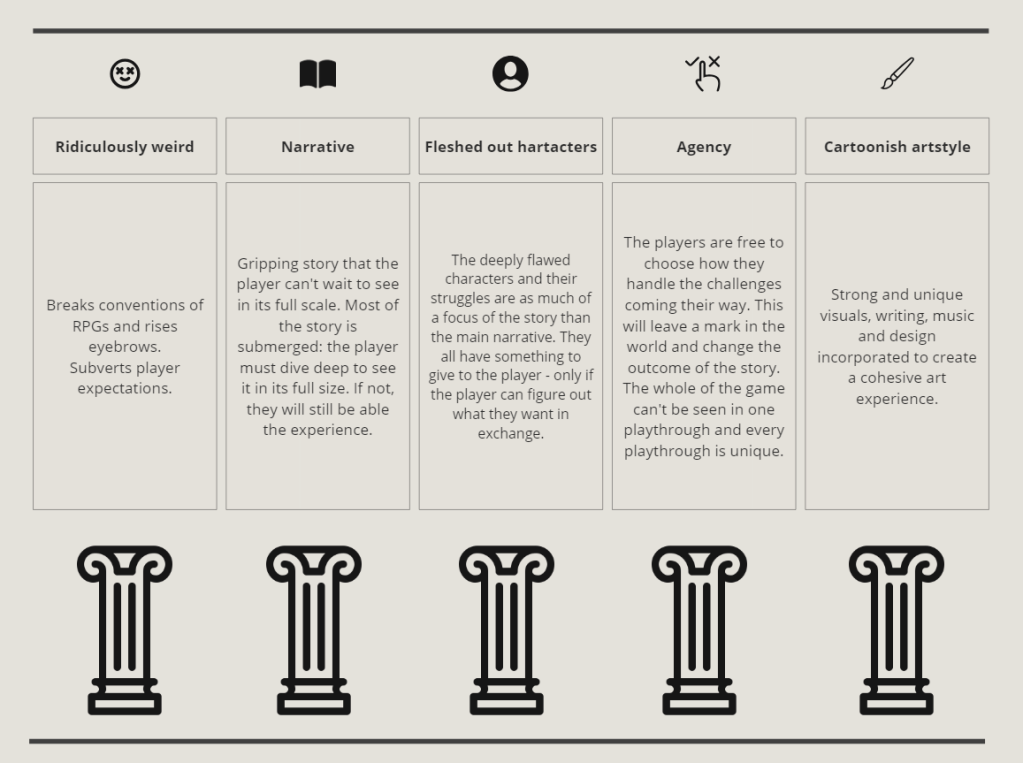
So—how do we keep the communication coherent through all those steps? First, we should establish game pillars for the project. They are parameters that limit and guide the process of design and production. In other words; they are fundamental concepts that the game wants to explore and be based on, and once stablished, they should be respected. Game pillars also help the team to understand how the project will be developed and be on the same page about what it’s trying to accomplish. Below are the pillars we’ve come up, when fleshing out the idea of Paradigm Island.

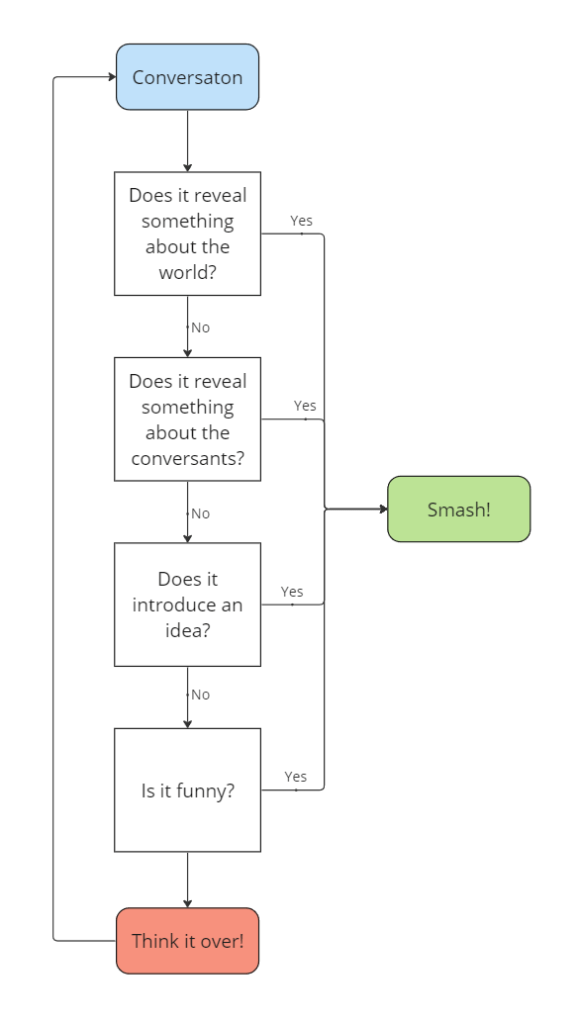
From time to time, it happens that a super awesome idea comes along, but doesn’t align with the established pillars. Then we will consider if it’s worth changing the pillars, and if so, the rest of the content will have to be checked to be sure that it goes along with the now changed new pillars. I’ve also made this flow chart to visualize the process of incorporating and weighing new ideas, or maybe I stole it from somewhere. Can’t remember.

Once the foundation is established, it’s much easier to make decisions and weight the consequences of possible changes on the scope of the production.

From the narrative point of view, the story’s theme should also be considered before getting too deep into the production, but that’s a topic for another blog post, since otherwise this one would get waaaay too drawn-out. Just keep that in mind, okay? We’re moving on!

Why?

How can we know if the point is coming across? The answer is, of course, testing. As soon as we have a feature in a somewhat playable condition, we should try to find someone new to the game to test it. It’s near impossible to know if something really works or not before we have someone—other than the people making the game—try it out. In our production, we try to follow a design loop like the one below. It’s much less organized than what’s depicted in the image, but we keep it in the back of our heads. The main takeaway from this could be that designing a feature shouldn’t be seen as a race where you make it and make it and eventually hit the goal when it’s ready, but rather as a loop that keeps repeating. I read a saying about game-making that went something like: “The game may be shipped, but it’s never ready”.

Once we have a feature that passes the filters listed earlier, we run it through this loop as many times as needed untill we feel like we succeeded with what we were trying to do with it. It’s worth noting that if an idea doesn’t catch on even after it has gone through this loop several times, it could be better to scrap it. More ambitious or original ideas would—of course—need more cycles than a basic quest system or something else time-tested like that. The core in the center stays the same and has to be understood by everyone in the team, and the game pillars make that much easier. It should also be considered why the feature is added; does it make the game more fun, make the message clearer, or add anything of substance? Making more content for content’s sake just adds unnecessary scope to the production and could even hurt the game’s core message. 

Testing can also be used in marketing, for example, in what is called A/B testing. There we would make two versions of the same add—with different art or something like that—, push them out, and see which one produced more clicks, reactions or that sort of of thing. We could also run the same ads to two different target groups and test what kind of customer profile—which I’ll talk more about a later— responds best to our game. I won’t get too much into testing in terms of marketing; maybe it could also be a topic for a different blog post. Damn, it’s hard to not get sidetracked into oblivion when writing these posts!

Broken Telephone

In Paradigm Island, the story follows Mike, an orphan boy adopted by a group of mercenaries as an infant, now starting his first day on the job as a hired gun. Based on this knowledge, the player could expect there to be lots of shooting and combat involved. However, that’s not the case, and we try to make that point clear early on. One could argue that making a mostly non-violent game that follows soldiers is—well—a bad setup. There’s the danger of people looking for non-violent games skipping this one, once they learn that it involves mercenaries. Why even choose this kind of setup?

Gun violence in games is so common nowadays—and has been for a long time—that it doesn’t feel like anything anymore.


I’ve always been interested in the darker side of things and the people behind the evil that goes on in the world. Gun violence in games is so common nowadays—and has been for a long time—that it doesn’t feel like anything anymore. Nothing against gun violence—in games—, but we’re more interested to explore in our story, what goes inside someone’s head when committing such acts and the impacts it has on them and other people. That’s what this game is really about. CONSEQUENCES! That felt like a word that would sound funny shouted out loud.
To make a quick note on that violence thing: Paradigm Island is, without a doubt, a violent game; it just doesn’t depict it that much straight on, but deals more with the aftermath and threat of violence and the structural forms of it, practiced by corporations and governments, than the act itself. That’s enough for the challenges we face when communicating about our game, for now at least; let’s take a step back.

Finding our people

When making a trailer, Tiktok, or Youtube video, or any other form of ad for the game, it should already be very clear, what the core gameplay loop is and what the theme of the story and the genre of the game are. Making a game for everyone is impossible so we should know who the potential players for our game are.

Here we can do a bit of market research and investigate; what other games are similar to ours, what did and didn’t work with them, what kind of people generally play these kinds of games and what are those people’s interests.

Making customer profiles can help us narrow down who we should market our game to. With our game, Paradigm Island, being a text-heavy one, containing strong language and concepts for adults, we can exclude children altogether from the target audience. Laso; before we have access to the resources for localization (meaning translating the game to other languages), it wouldn’t make sense to market to countries where English is not the first- or generally fluently spoken language. Our game deals with social and environmental issues so one could also assume that a college student is more likely to have an interest in these topics than a middle-aged salesperson. These are all generalizations, of course, but we already have a better understanding of where to focus our resources, what kind of lingo to use in the marketing, and from which direction are we more likely to get a response. Below is an example of a customer profile of an ideal person to market our game to.

Final Thoughts

We would love to just focus on making the game and once it’s finished, release it to the players, brimming with excitement and eager to get their hands on it, but I’m afraid it isn’t quite as simple as that. Every month, thousands of games get released on Steam alone and if you want to get yours noticed, you’ll have to be prepared to scream your throat sore about why it’s the best thing out there. And not just scream, but scream smartly. You’re not competing with just other games either; all other forms of entertainment and activities are competing for the people’s attention just as much as games; should they watch Netflix, play our game, or go outside and touch some grass? If they chose your game, you’ve done something right! Lucky for us game-makers, it’s not like people buy only the games that they’ll play straight away; many gamers have a ‘backlog of shame’, full of games they’ve bought and been meaning to play, but just haven’t found the time to.

All right! That’s all the energy I have to write about these topics for the time being. I hope there was something new to you, and if not, at least interesting. To give a quick update on where we are with the game; we’ve had quite a bit of live playtesting lately and now we’re taking a break from that to lick our wounds and to get the first draft of a skill- and inventory system working for the next round, along with some polishing and bug-fixing and whatnot. It’s always super exciting to see how other people react to what we cooked up, so totally looking forward to the upcoming test sessions! I’ll post some game footage and more of that sweet flashy stuff in the days to come.

That’s it! If you want to follow our game-making journey and keep updated on the following posts, click the button below; it will take you to a landing page where you can subscribe to our e-mail list. Cheers!

It’s a looker!

It’s been a while since I posted an update here; been so busy at work that I simply haven’t had the time. I’ll pick up the phase and start making shorter, more compressed updates on where we are at to keep this blog alive and healthy. The goal was to make the process transparent after all.

So, what’s up?

I can proudly say that we’ve got the first playable demo of the tutorial up and running! It’s unpolished, buggy, and lacks many of the mechanics and features we want to include, but it’s alive!

We took part in Living Game Intelligence Network game workshop, in which we got some priceless feedback on the demo; it was an overwhelmingly positive experience and we definitely intend to conduct regular playtest sessions in the future. It’s hard to see the forest for the trees when you’re looking at the game every day and getting some fresh eyeballs on it from time to time totally helps to notice flaws. If you’d be interested in playtesting the demo, feel free to holla me via email, Linkedin (Oskar riekko) or just comment below this post.

Sneak peeks

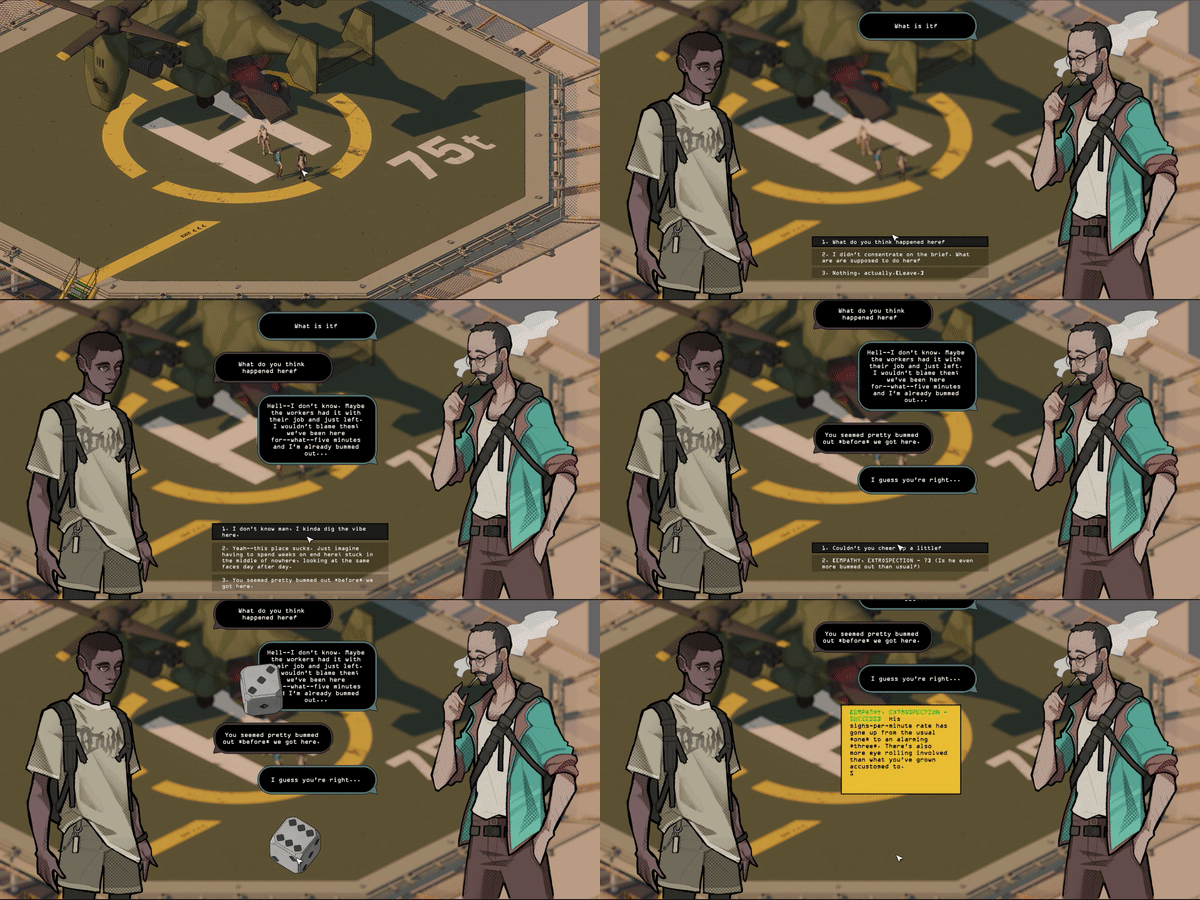
Finally, finally, finally we’ve got something to show of the game! Here’s footage of the game’s core loop; the dialogue and the skill checks incorporated in it. Still a work in progress, but all the puzzle pieces are in place.

Conversation with a fellow mercenary; a moody Frenchman named René.

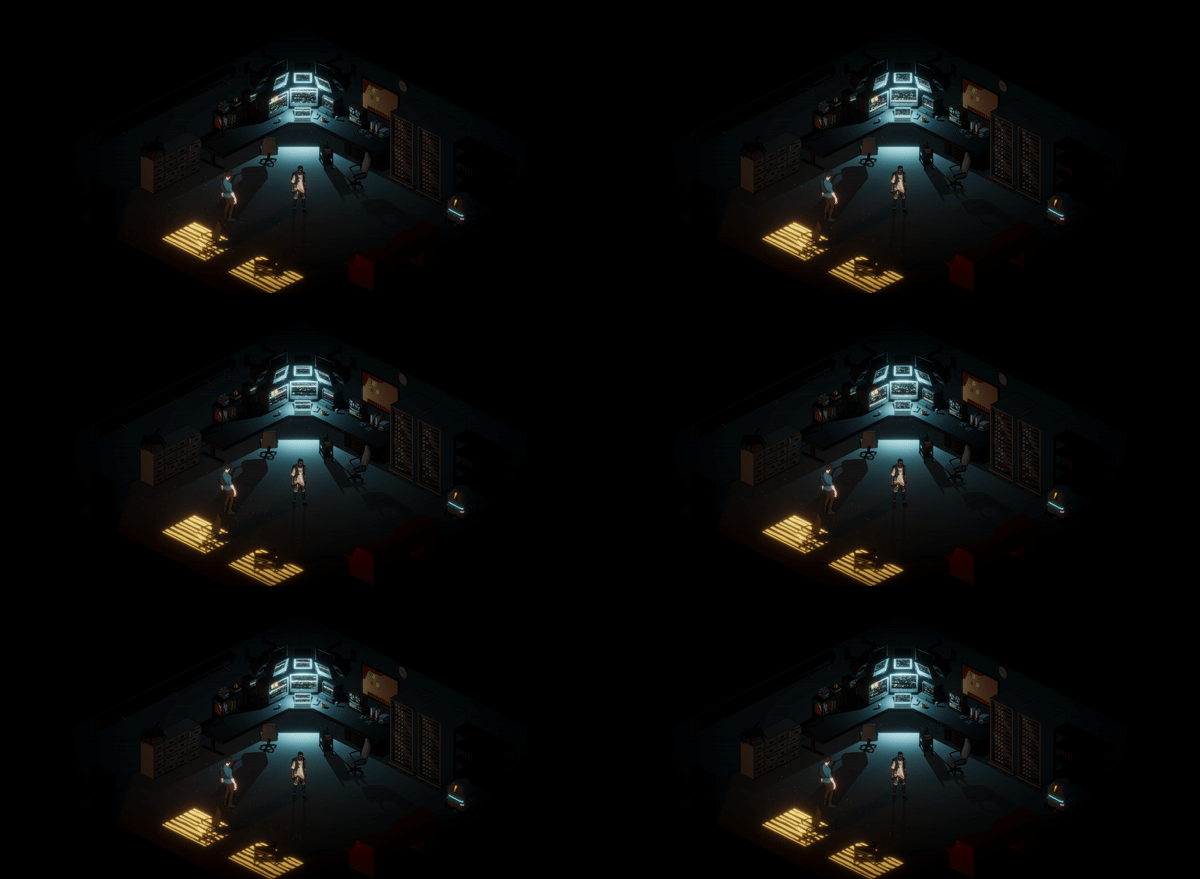
Here’s another one from one of the more finished interiors. It misses some clutter, cables and whatnot, but it’s definitely starting to look like something!

An oil rig’s surveillance room. A service robot is doing a terrible job at hiding in the corner.

This is all I’ve got to show for now, but I’ll post more once I can find the time.

If you’re interested in following our game-making journey, click the button below; it will take you to a landing page which allows you to subscribe to our email list.

Smell you later!

Comics, cartoons, funny papers

I sat down to write a bit about why we’ve chosen to mimic the aesthetics of vintage comics in our game and what goes into making it look authentic. To be more specific about the influences; we mostly draw from the golden- and silver-age comics that originated in states—your Super-mans and Wonder-Womans—and the ones from European parallel periods, like Asterix, Tin Tin, Lucky Luke and what have you. I’ll point out straight away that this won’t be a tutorial on how to make a game look like a comic, nor will it be a piece of well-researched journalism—though feel free to correct me if I say something egregiously wrong. There’s also going to be some over-simplifications to keep this tight. Let’s just be safe and say it’s a collection of thoughts and notes, okay?

Before we dive head-on into this comic stuff, let’s take a short detour to talk a bit about something that crystallizes the point of this post. Raison d’être is an expression coined by Philosopher John Stuart Mill in the 17th hundreds, meaning ‘the reason to be’ or ‘a purpose of existence’. Some examples of this could be: a chimney’s raison d’être is to let smoke out of the house, Michael Jordan’s is—or was—to play basketball, and Mozart’s was to make music. This blog’s raison d’être is to document the making of Paradigm Island. Now; let’s not forget this because we’ll get back to it later. Time for an awkward transition.

A teeny-weeny slice of comic historeeny

Back in the ‘good ol’ times’, comics were made for the newspaper’s ‘funnies’; the section at the end of the paper that contains comic strips. With limited time and technology, certain compromises had to be done and out of those compromises birthed an effective storytelling medium. As a side note—one could make the argument that the Egyptian hieroglyphics or illustrations on Greek vases were just ancient comic strips; I’m not making that argument since it’s not the point here.

“Comics have evolved to tell as much as possible in a confined space with the least elements necessary.”

About those compromises I mentioned; let’s say you’ve got a couple of hours to make a comic strip. Assuming you’ve got some kind of a story, joke, or message figured out, what would you get down first? That’s right; the outlines. Got a few more hours to spare? Maybe shading? A couple more? Background, maybe? What I’m getting at here is; the comic artists had to be very resourceful with the time they had and only draw what was necessary to get the point across. The comic makers had to know the—yes, you guessed it— raison d’être of every element that was put on paper. How’s that for delayed gratification? Anywaythe bottom line here is that comics have evolved to tell as much as possible in a confined space with the least elements necessary. Of course, modern comics—not to mention graphic novels—have much more space to express themselves but they still carry this history in their DNA.

Getting to the point

So why? What is our raison d’être for picking this aesthetic for our game? Why choose to use these neat 21st-century tools to recreate an old, flawed media? Do we really need one, besides that it looks cool? Maybe not—it’s just that picking an aesthetic like it’s a pack of cereal from a market shelf and then planting it on something in hopes it sticks doesn’t sit right with me. I don’t want this game to be a copy of a copy, exhausted of meaning and authenticity; a Frankenstein’s monster, glued together from whatever random bits and pieces we could find. I want it to be something thought out; living rather than just undead.

“With our look, we hope to be able to deal with heavy topics without the game becoming so gloomy no one bothers to play it.”

One thing this kind of visual style does a good job at is taking some weight off of the subject matter it deals with. In our case, we hope the playful and cartoony look will balance the foreign, bleak-in-tone, and futuristic setting of our game, helping it feel a bit more grounded if you will. One more for the road; with our look, we hope to be able to deal with heavy topics without the game becoming so gloomy no one bothers to play it. The visual storytelling–starting with aesthetics–communicates there’s also humor. The style could perhaps even be categorized as camp since it’s gaudy, exaggerated, and ironic.

If I was to name a few pieces of media outside of comics that greatly benefit from their cartoony aesthetics, the TV-show Bojack Horseman is the first one to come to mind. If the show was told in different form; with real actors, for example, it just wouldn’t work. Of course, the case is a little different with games–though they have actors too nowadays–but I don’t think the medium is as relevant to the topic here as the form.

More on making things feel ‘grounded’

If you’re about to yank the viewer–or in this case; the player–to a world unfamiliar to them, you should at least show some human decency and let them bring something to remind them of home, right? If you just dump a truckload of new stuff on them, they’ll run away scared. I think it’s safe to say that everyone’s familiar with comics and most of us that have reached adult age by now have a nostalgic relationship to them.

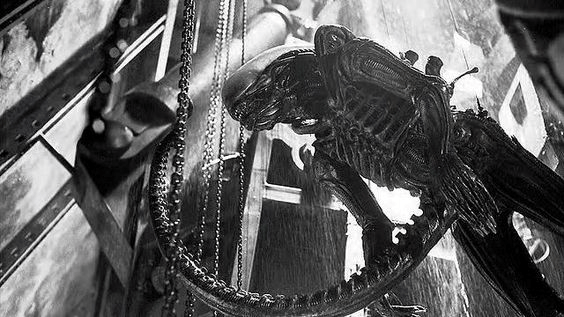
An example of grounding that pops into mind is from the first Alien movie and the scene in which the alien kills Bret, one of the Nostromo’s crew members. The chains (image below) hanging from the ceiling in the scene do a great job of grounding it, working as an anchor of sorts to the world familiar to the viewers; this way, it’s easier to place oneself in the situation at hand and the world of the movie. Without the chains, the sci-fi setting would feel a tidbit too other-worldly to be scary if you ask me. The added dripping water is the icing on the cake. Of course; sometimes you *want* the scene to feel alienating–pun intended–but let’s not go on a tangent here. I know this was a bit of a stretch but when I saw a video on Youtube talking about this scene, something clicked with me so I thought I’d share. Let’s get back to comics.

The chains and dripping water do a great job of grounding the scene. Also; look where the alien’s tail is growing from. What did you say it looks like? Ew! You’re grounded!

Paradigm Island’s inhabitants are often morally ambiguous, selfish, and prone to temptations, with no metanarratives to guide them.

Comics were originally not just a medium for comedy but for political satire as well. By choosing this visual style, we tip our hats to the past and continue the tradition in a new medium. It goes without saying that some things–like racial stereotypes and sexism–are better left in the past but we can still appreciate the things done well; at least as an expression of skill. Arguably the first American comic, ‘The yellow kid’–and the yellow here not signaling anything racist–was made to, and I quote:  “to make wealthy readers more sympathetic to the plight of the poor.”

The heroes in the golden- and silver-age comics were depicted as moral role models who fought for the greater good; strong in their beliefs, courageous and virtuous, existing naively in a world in which the lines between right and wrong were clear. This isn’t the case with our game. Paradigm Island‘s inhabitants are more often than not morally ambiguous, selfish, and prone to temptations, with no metanarratives to guide them. The contrast and irony aren’t hard to draw; in a way, the medium becomes the message.

B-b-b-break it down!

So, what steps do we take to make our game look like a vintage comic? I’ll start with an obvious one: outlines. They make the shapes fast to read and help us control the visual hierarchy of what is shown. In other words: it makes different objects stand out clearly. Yeah–water is wet–I know. Moving on.

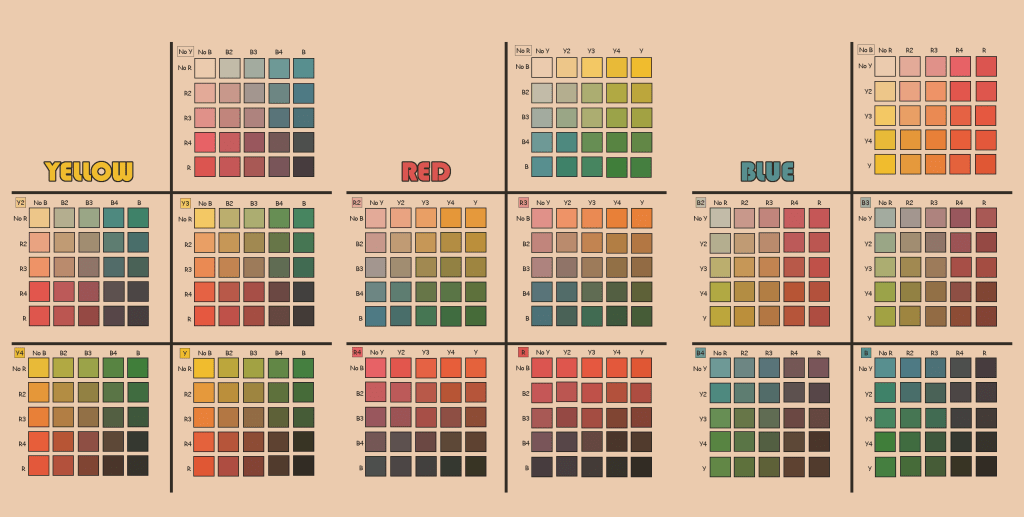
Next up: limited set of color. We use a color palette consisting of yellow, blue, and red (magenta). On top of that, we have white and black. Of each color, there’s a solid 100%, 75%, 50%, and 25% versions and the palette consists of different mixes of all those shades. For example: orange’s color code would be Y4R3; Y4 meaning solid yellow, and R3 75% red.

Ink bleed: when the image is printed on the paper, the capillary effect moves the ink on the paper before it gets to dry, making edges a bit jagged if you look closely. It’s a subtle effect–yes–but subtle effects add up.

Here’s the same font with ink bleed and without it. Of course, it’s not real ink bleed since I made it in Photoshop.

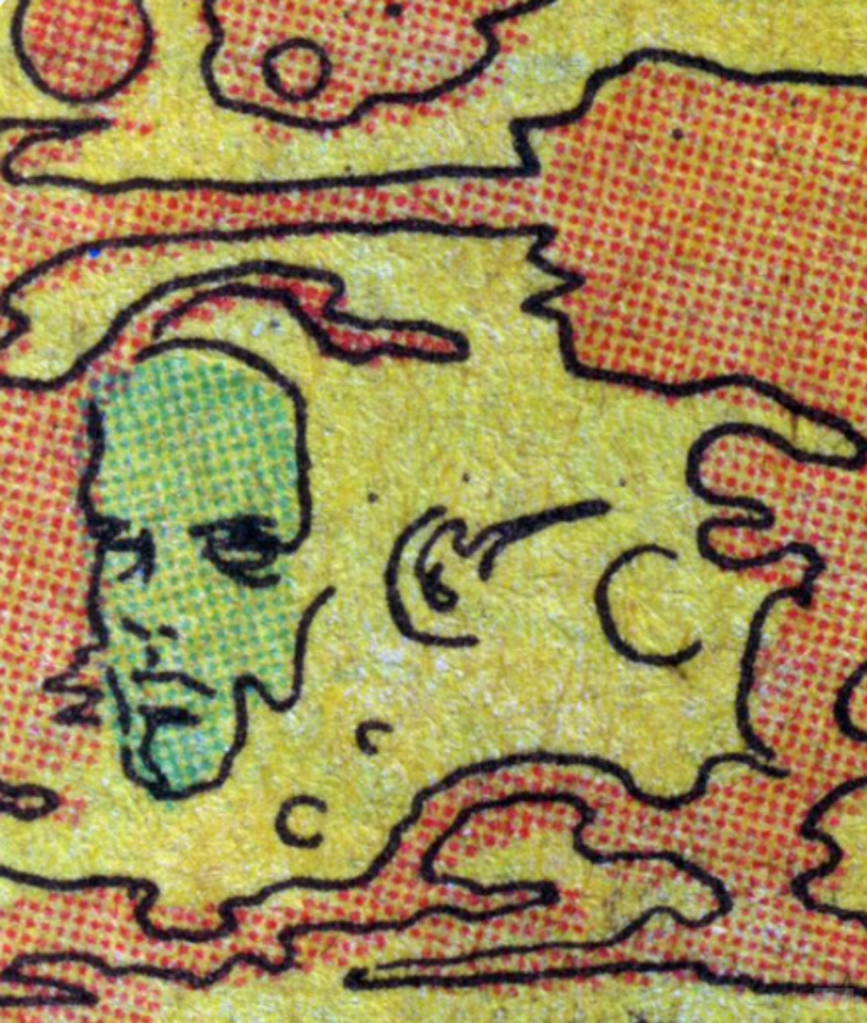
Fourth: halftone, meaning little dots that create gradients and color combinations when varied in size and spacing. For example, to create orange color, we would overlap solid yellow dots with 75% red ones. There are different styles too: like in the image below we could also layer red dots on top of a solid yellow. The size and spacing can vary significantly, depending on what was the budget for the comic and when it was made.

Misaligned linework and color: If I’ve understood it correctly, back in the day the black-and-white art was sent to the production department and colors were laid down separately. Other times the artist would color the images and then they would be recreated by the color separators. The colors made by the artist would’ve been only guides and never saw print exactly as how they were intended. Sometimes the overlays would slip and an object would have the color a wee bit to the side; that’s why it seemed like the comic artists couldn’t stay within the lines when coloring.

An extreme example of misaligned colors.

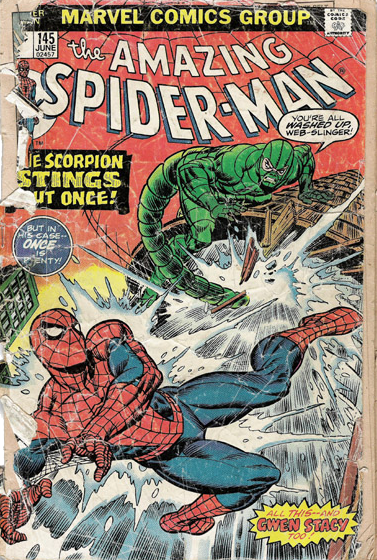
Aging: the colors would fade over time and the pages would get a yellowish tint. Also; the pages rubbing against each other would wear the images and colors. The image of old comics most of us–born way after the ‘golden age’–have is not accurate of how they were straight out of printing.

A dilapidated issue of Amazing Spider-Man.

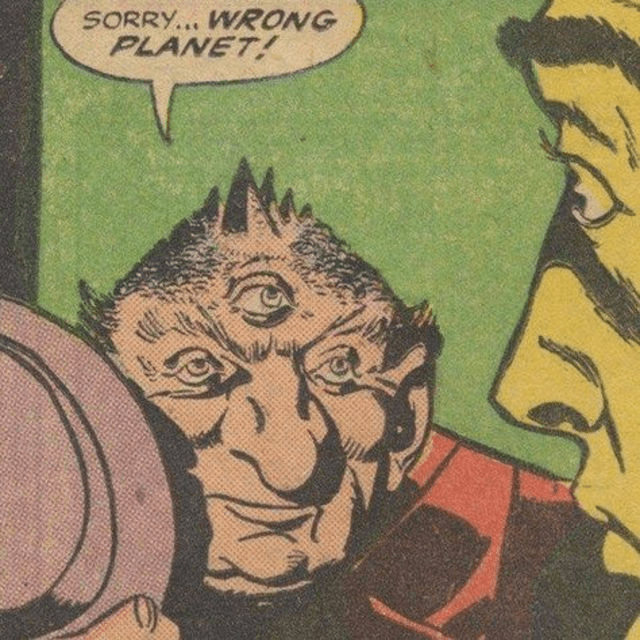
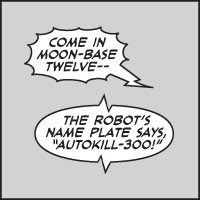
Almost forgot! speech- and thought bubbles: These are the first thing to come to mind when talking about comics, are they not? Though bubbles are nowadays mostly seen as corny and replaced with narration boxes, which can too sound a little dated if not applied properly. Like in the image below, the visual style of the bubble can tell what the source of the sound is, for example, a walkie-talkie or a robot. With a text-based game like ours, these visual cues help tremendously to get the point across.

Narration boxes: In vintage comics, the narration box was reserved for the omniscient narrator but in the modern ones often used to give a glimpse into the mind of a character. When comparing the narrator box to a thought bubble as a means to describe the thoughts of the character, I think it’s safe to say the narrator box feels more elegant and the thought bubble more comical. Since we are going for the nostalgic and comical tone in our game, we’ll most likely use both, depending on the situation.

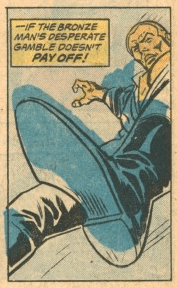
Lastly, there’s the editor’s footnotes, mostly seen in older American comics. In context of our game, they could be used to give more information about the world or the main character’s past but that’s something we haven’t been talking about much yet.

Example of editor’s footnotes.

I hope I didn’t miss anything crucial. If I did, I’d love to hear about it! we’re still figuring out which of these elements will be done in the actual texturing of the 3D models and which in post-processing. Some of them could still be dropped and something else added; after all, our aim is not to recreate the style of vintage comics religiously or stick to one specific look from a certain period but to come up with an identifiable and intriguing look.

If you want to follow the development of our game or just share our interest in all things art, consider subscribing to our email list by clicking the button below; that way you’ll get notified whenever there’s a new blog post or other news about the game. If you got anything to ask or feedback to give, you can leave a comment below or email me at oskar.riekko@paradigmisland.blog

On branching video game dialogue

If you were to make a video game consisting mostly of dialogue, you’d be smart to make sure it’s interesting, right? I think so too. Now; how to make it interesting is somewhat of a more complicated question, a question some folks have spent their lifetimes trying to come up with an answer for. Fortunately for you and me, some of those folks have written down what they’ve come up with, and what’s best: some of it is free on the internet. How to make dialogue interesting is one thing, but how to make it interesting and make it make sense in a branching narrative, in a way that leaves you with a coherent story, is another. I’ve gone through the internets and gathered some things I think are worthy of putting down. I’ll add some thoughts of my own into the mix as well.

Straight off the bat: saying everything there is to say about branching video game dialogue is not what I’m trying to accomplish in this post. There’s whole blog series about the subject—among all the other stuff—out there. However, this is a game dev blog about all things having to do with the deving of our game and the things we learn while making it, so it’s more of a personal look at the subject and a form of documentation, if you will.

I’ll be going over some of the tricks I’ve found useful when writing Paradigm Island, as well as some of the “rules”—or rather guidelines—that have helped me to stay on track. I’ll also give my personal take on when I think it’s smart to break those rules or forget them altogether. If you’ve looked into the subject, you’ll notice that some of the stuff I’ll say is the most basic shit you’ll ever come across. I think it’s good to go over it anyway, in case someone reading this is new to it. It’s not like I have it nailed down to a tee myself so this is partly me trying to internalize it.

Where to start?

To keep the focus of this post on dialogue, I assume that we’ve got some kind of framework for a story. I’ve used Hero’s Journey, popularized by Joseph Campbell, and Dan Harmon’s adaptation of it, called Story Circle, as well as Save The Cat by Blake Snyder. If you’re not familiar with any of those, they’re frameworks, made for stories that involve a hero who goes on an adventure, goes through a crisis, and comes back changed. Most of our Western “entertainment” revolves around those templates, be it movies, TV, games, or books. I’d like to add that these kinds of templates have been criticized for encouraging writers to rely on writing that is familiar and successful rather than encouraging creativity and originality as well as leading to formulaic storytelling. My humble opinion would be that they’re not so much something to go by but rather something to understand.

“Most of the things I talk about here people do unconsciously anyway.”

For me, what works best is to just write something. Anything really. It’s easier to just write something and come back to it later with a more critical mindset than to plan the living daylight out of it beforehand. As they say; “writing is thinking” and you get ideas as you go. Putting too many restrictions on how the dialogue should be and what it should accomplish is enough to make anyone freeze. We don’t want to get stuck looking at the empty “paper”. It’s art after all we’re making, not science. I once read a quote about music theory going something like: “It’s good for explaining but not so good for creating”. Kurt Cobain didn’t know the names of the chords he was playing, nor did Jimi Hendrix. William Shakespeare didn’t know what a Story circle is. You get the point. I think you can get pretty far by just doing what feels right. Most of the things I talk about here people do unconsciously anyway. Of course, if writing anything at all in the first place is your problem, this mumbo-jumbo won’t do much for you. Where are the tools and rules I promised?

“When the story has characters, all wanting different things, it almost writes itself.”

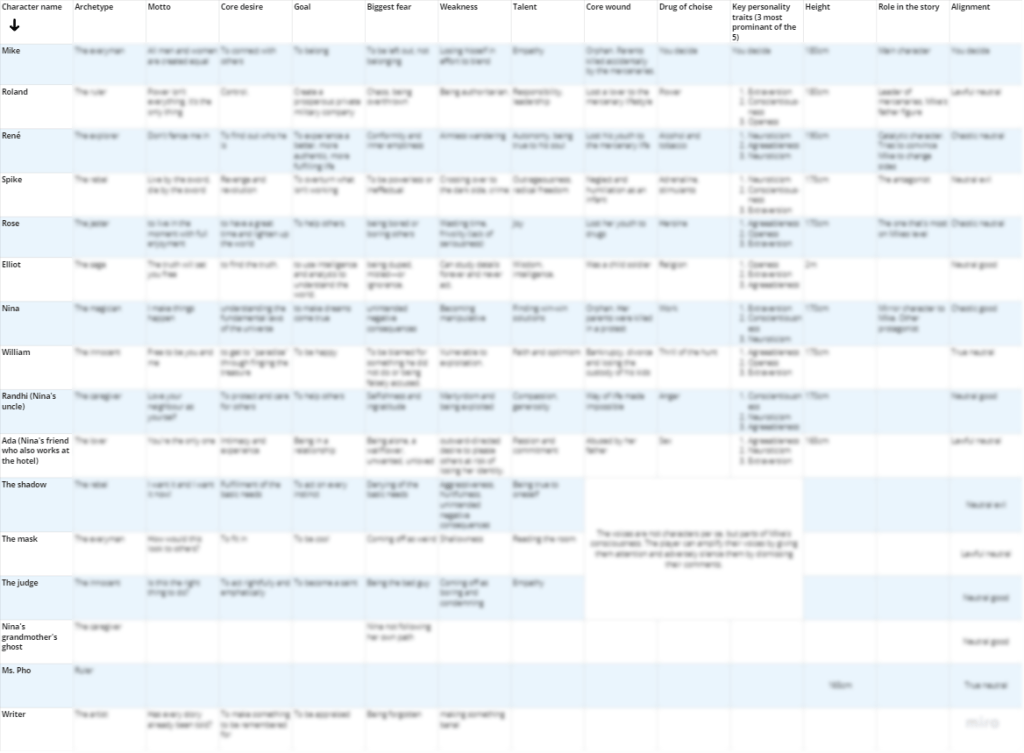
Well, to come up with an interesting conversation between two characters, it helps tremendously to know what they want. You as the writer of course get to decide what they want, so my advice would be: make them want different things. That’s how you get conflict, and we love that shit, okay? The conflict’s where it’s at. When the story has characters, all wanting different things, it almost writes itself. Almost. For me personally, having all the significant characters put in a menacing diagram like the one below helps. There I list their core desires, core wounds (traumas, regrets), goals and fears, among other things. This way I can sort of check on them if they’re staying in character. Of course, sometimes you get new ideas as you go and then you adapt and change things. Again: it’s not science.

What next?

This far we’ve established that characters should want something. Hooray, right? Not exactly revolutionary. Every game’s full of characters wanting something and having something to give to the player if the player gets them what they want in exchange. That’s fine and great for some purposes but we’re not stopping there. Now that we know what our characters want, we can proceed to figure out what they actually say.

Often in games, the non-player characters tell the player very straightforwardly what they want. However, when we’re going for a more nuanced, real-feeling dialogue, we should consider something called filters. What’s filters, precious? Well, you know when your dad doesn’t want you to go to that art school you so badly want to go to (conflict spotted) but doesn’t say it directly to you? Instead, he might say something like: “I heard the neighbor’s son is making big bucks in the steel factory.” Wha-bam! That’s a filter right there, in the flesh! The subtext here of course being: “You should do something worthwhile instead of going to the art school”. People don’t usually express themselves straightforwardly. It all comes through a filter, figuratively speaking. That’s just the way it is. Sometimes people don’t even know what they want. They say they want that, but really they want this, and even though they want it, that’s not what they really need, and what they really need is not the thing they want. There’s a lot of room to play around there. Sure, some people can be very blunt about their wants and that can make a interesting character too, but that’s hardly ever the case in the real world.

What’s real?

So is realism what we’re going for here? No. Well, sort of. Let’s take a few steps back for clarity’s sake.

What’s a character really? Taking the dictionary character definition, the word means “a person, animal, or being within a story”. I’d like to draw your attention to the last three words. Within a story. What defines a character, is that he or she is in a story. Now back to the real world: people sometimes just agree on things and want the same things. Their conversations are not always full of conflict and drama. Those are people. We are writing characters. People don’t make for excellent characters without a few tweaks, usually. You should absolutely use people as a reference for your characters (please use common sense and human dignity here) like you should look at real buildings before you paint an imaginary one. Realism in art is just often dull. Boring. It doesn’t say much. Sure, there’s a place for that too and it can be impressive, but we want to say something, right? We’re not making a documentary here. We’re writing a story. A documentary game would be really something though.

Are we lost?

So; we want real-feeling dialogue but we’re not aiming for realism. What the hell? Bear with me. Let’s just keep on digging. Sure, we want the dialogue to feel real but at the same time we’re trying to pull a magic trick: we want the dialogue to be in service of the story, and carry it towards a conclusion where the conflict is resolved. That’s a lot to do at once so let’s keep at it.

Now would be a time for another example:
In Paradigm Island – or in one of its dimensions – our protagonist Mike wants to prove his worth as a mercenary to his father figure Roland and the other mercenaries that have raised him. Mike’s core desire is to find his place in the world and this way he wishes to fulfill that desire. At the same time, Mike doesn’t want to hurt anyone. It’s just that when one works as a mercenary, people often get hurt, so there we have the conflict again. Roland – the leader of the mercenaries – lost his loved one long ago to the mercenary lifestyle and doesn’t want something similar happening to Mike. He likes that Mike looks up to him and that he appreciates his opinions but doesn’t want him to follow in his footsteps. Then again he doesn’t want to admit to himself that he misses his lost lover and that the mercenary life’s not that glamorous when one actually lives it. The theme of Paradigm Island is personal growth and coming-of-age, so that’s something to be taken into consideration when its characters have a conversation, as well as their wants, without forgetting the filters. For the conflict to resolve and the story to reach its conclusion, Mike could realize that the mercenary lifestyle is not suitable for him and that Roland will accept him no matter what he chooses to make of himself. Roland on the other hand needs to admit that he should learn to open himself up to be able to live life to its fullest.

In this example, both characters have human and understandable wants but they also serve a theme and a narrative. In the end they both learn something from one another and everything ends nicely. If both just expressed their wants without filters straight away, there wouldn’t really be a story here. The story’s theme is a subject I’ll save for another post.

What if the dialogue still sucks?

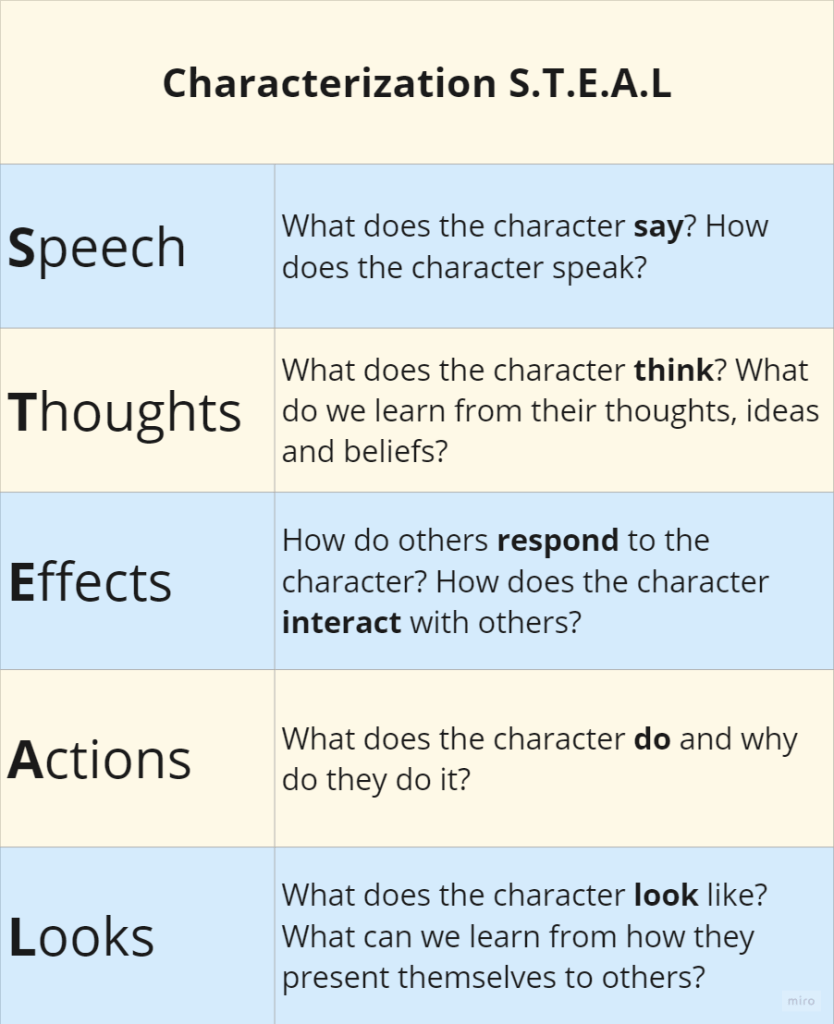
That happens. There’s medication for that. When something a character says or does doesn’t feel right, I try to figure out what’s wrong with it by running it through this filter. Sometimes it’s just that I’m tired and haven’t eaten.

If nothing a character says feels right, do they have to say anything. Saying nothing is also saying something. Maybe they roll their eyes? Maybe they blush? This S.T.E.A.L diagram could also help you out.

Also: time is a good critic. We can step away from the text and then look at it again after some time has passed. We could also read it out loud. Also: if the dialogue feels good, it is good. No need to needlessly complicate it. As with most rules, you should know about them and then forget they exist. Don’t let them hinder your creativity. Only when things are not working should you come back to figure out why. Keep things organic and not too perfect. Perfect is boring. You get perfect out of a machine.

Listen to what people say and how they say it. Why are they saying it and not something else? What mannerisms do they have in their speech, like phrases or words? For example: some upper class, aristocratic character wouldn’t end his or her every sentence in “You know what I’m saying?”, you know what I’m saying?

Let’s go and make the game already!

Now hold your horses! This is a branching narrative, remember? Yeah, I know. Oh golly…

In a branching narrative, the player gets to choose how they want the story to progress, what they’ll ask the non-player characters, and how they relate to what’s being said, with certain limitations of course. How the hell do you make a coherent story and pull resolving character arcs out of that? It’s a sensible question. Is the game destined to be a disoriented, deranged mess?

Not necessarily, though it might come to that if we’re not careful. We’ve got tricks up our sleeve: Knowledge, data and basic human psychology. We as human beings are somewhat change-resistant animals. In other words: we typically don’t like change. Okay, yes, maybe you do, you precious snowflake, but we’re talking generally. This we can use for our advantage. When a player makes certain kinds of choices, he or she usually continues to make those kinds of choices for the rest of the game. If they are playing as a hero they aren’t likely to start playing as a villain all of a sudden, unless given a good reason to. Now this comes with certain challenges too. For the character arc to be satisfying, we want there to be change. A story with the main character starting a certain way and being the same way in the end isn’t a really a memorable one. So how do we make it happen without taking out the player’s autonomy?

Let’s make the player struggle a bit to remain the character they are role-playing as; to keep things interesting.

The answer is: reframing. Let’s say the player decides to be a hero and goes around doing virtuous acts. How about if by the time the story has reached its midpoint, it turns out those virtuous acts weren’t so virtuous after all? For the sake of making a point, let’s say that they’ve been fighting rebels for some time, slaughtering them left and right in the name of law and order. Then it turns out the rebels had a good cause to fight against the status quo that the player has been fighting to protect all this time. This way, even if the player keeps acting the same way, the character has changed, now knowing more about the situation. See? Magic! Now the player has to make an informed decision and we get that sweet sweet conflict that we so much desire, not only in the character but in the player too. If the player wants to remain, let’s say, for the sake of an example: a goodie, you should make the story play out so that he or she can’t keep making the same kinds of choices all the way. Let’s make the player struggle a bit to remain the character they are role-playing as; to keep things interesting. The player should also be given dialogue options to express their inner conflict about the fact. Let them speak their mind in the game. That’s immersion baby!

Fun side note I remembered from some interview with the creators of Disco Elysium: If the player kept saying “sorry” a lot in the game, the game took note and made fun of them for being a “sorry cop“. The player data showed that people started playing as total scumbags after the fact. Be careful!

Free will

In a game with multi-branching dialogue, it goes without saying that with it comes the promise of autonomy and freedom of expression. We want to give the player as much freedom as possible but at the same time, we don’t want to lose the story. It’s give and take; you sacrifice some coherency of the story for player autonomy and the other way around. With complete freedom – which in itself is impossible to achieve in a game (maybe in life too, eh?) – it’s impossible to have a balanced story arc. All that being said, we can end up winning on the trade-off if we know what tools to use.

The first trick would be the Illusion of choice. Sometimes it works as well as the real deal. Every decision doesn’t have to change the story as long as the game recognizes those decisions in some way. This, however, is where we want to be mindful; if it’s all bluff with no real effect on the story, the players will pick up on it. They are not stupid after all. Of course, we can’t have every single decision have an effect on the story. It’s a game of balance. We gotta mix it up. Below’s an image to demonstrate the Illusion of choice.

The second trick would be bottlenecks. It means that we can have the story branching somewhat freely for some time but then we guide it back to a single place where it all comes together. From there on, it can start branching again. We can repeat this process as many times as necessary. This way the story doesn’t get exponentially complex as it progresses. Below’s an image to demonstrate a bottleneck.

To keep things simple, I’d start by forgetting choices and bottlenecks for a while and focus on making one linear version of the story that has our hero 1. going on an adventure, 2. getting into a crisis, and 3. coming back changed (the hero’s journey). Once we’re done with that- and I’m not implying that it’s an easy task – we can start thinking: what if the hero acts differently? How can we make a story with those same building blocks out of that? Let’s use our imagination a bit here; what kind of different play styles could the game be completed with? Maybe the player wants to be cool and on top of the situation at all times. Maybe they want to wreak havoc and inflict suffering. Here we’ve got room to insert some of our own values into the mix. If you don’t want there to be bloodshed in the game, we can just exclude that. One example that’s common in games is that you can’t wack children. Fair enough. Of course, we can – and should – also ask the players: “Did the game allow you to play as the character you wanted to be?” Of course, if the answer is always “No. I wanted bloodshed”, we must think over why is that. Let’s not get too crazy about how many different play styles the game can be run through with. Not yet anyway. For starters, and for the sake of the argument, we’ll go with three very simple ones: you can be good, evil, or chaotic.

“The thing about us human beings – other than that we’re change-resistant – is that we are pattern-seeking.”

Now; how would you go about making dialogue based on these three potential play styles we just came up with? One thing I’d keep a close eye on would be that whenever the player is chatting someone up, they’re presented with dialogue options that let them be one of those “playable characters”, meaning in this example: good, evil, or chaotic. However, if that’s the only rule we follow, the game will be ass.

The thing about us human beings – other than that we’re change-resistant – is that we are pattern-seeking. If it’s too easy for the player pick up what you as the game maker are up to, they’ll start thinking that you take them for an idiot, and we don’t want that. Here reframing comes handy again; we can make it so that as the player gains information of the world, the choices they make are shown in a new light. Knowing that someone has a phobia of water makes you reconsider inviting that someone swimming and then continuing to tease them if they refuse, right? Let’s keep the player guessing.

How to actually make the dialog in the game

For the making of Paradigm Island, we’re using Dialogue System for Unity from the Unity asset store. It has proven to be an excellent tool and made it possible for me to work on the game without actually knowing any coding. It makes it easy to make conditions like: “If character A said this, then a dialogue option with character B can be accessed”. Below is a screenshot of how an actual conversation with an NPC would look in the Unity game engine. It’s intentionally blurry to not spoil the content.

Final thoughts

In Paradigm Island, we are still exploring how much we actually want the player to be able to affect the plot. At its core—and its theme being personal growth—it’s a game focusing more on the inner conflict than the outer. It’s not like we’re making a sandbox game either. Telling a gripping, emotional story is our main priority. Freedom of self-expression – while still being important – is second. Maybe rather than giving the player a hammer to mold the story to their liking, we could let them choose a lens which they see it through. The world can seem to be full of dangers or full opportunities, depending on what the person looking at it has gone through. Maybe we can use that to our advantage in the game. It all comes back to reframing.

I merely scratched the surface here and there’s still much I’d like to talk about considering this subject. However: to not make this post absurdly long I’ll save the rest of it for the next post.

Would you like to follow the creation of Paradigm Island?

By clicking the button below, you can subscribe to our mailing list. That way you’ll get a heads-up whenever there’s a new blog post or other news about the game. I’m planning on publishing a new blog post every week or so. If you have any comments on what you would like to know about or any feedback we’d love to hear about it! You can leave comment or feedback below or email it to me at oskar.riekko@paradigmisland.blog.

Further reading:

Blog series about branching dialogue systems

How to resolve the tension between story and interaction

Developing Meaningful Player Character Arcs in Branching Narrative

How Disco Elysium approaches the problem

Tabula Rasa

Howdy! I figured now would be the time to start a development blog for the game we’ve been making with a small friend group of five people. The game goes by the name Paradigm Island and we’ve been working on it for almost half a year now and are currently moving from pre-production to production-phase. Some marketing-savvy people have told me that the best time to start promoting your game is yesterday. I guess today would be the next best option, so here we go.

What is this?

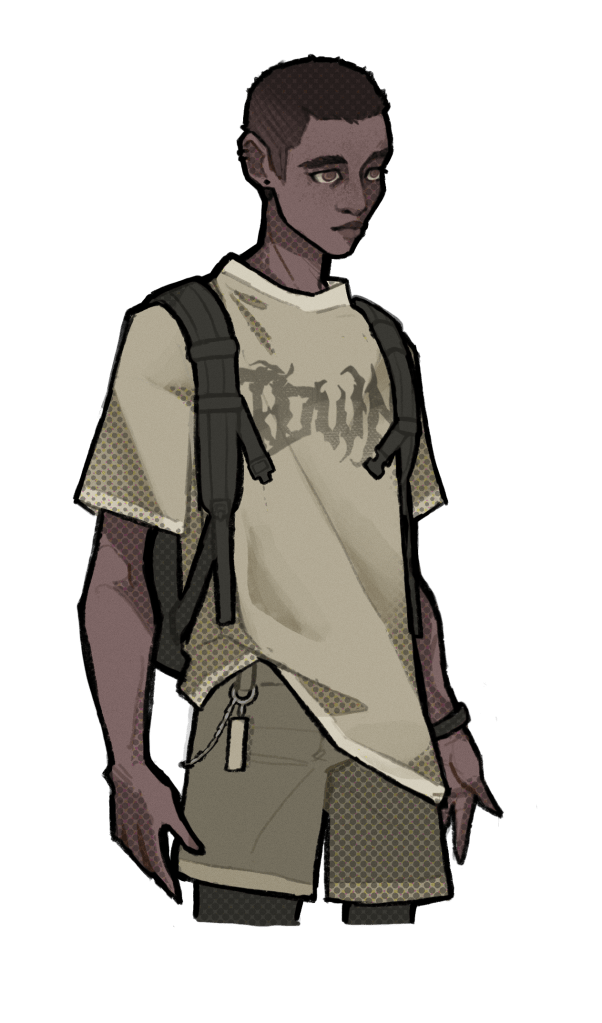
The game could be categorized as an interactive drama or more traditionally a role-playing game. I like to think of it as a post-modern satire, but that’s not exactly something that sells a game, so I’ll stick with the role-playing game for now. It’s a story about addiction, trauma, and people’s day-to-day struggles in a world where the lines between fantasy and reality are often blurred. That must’ve sounded really bleak but I underline that it’s all wrapped up nicely in humor and satire. The story puts the player in the shoes of an orphan boy named Mike, adopted as an infant by a group of mercenaries. The player’s job is to help Mike find his place in the world on the verge of adulthood and to guide him past – or towards – the skerries of life. This here is Mike, our protagonist.

How does it play?

Paradigm Island is a game you can play leaned back in your chair, legs on the table, one hand on the mouse, and the other hand holding your beverage of choice. All you need to do is summon the willpower to click on things that seem interesting to you. By the act of this clicking you get to discover the deranged world of Paradigm Island and meet its equally deranged occupants.

The bread and butter of our game are its characters, who we’re sure you’ll love to hate and hate to love. You’re free to chat with anyone and strike up conversations about life, death, philosophy, music or just to ask instructions on how to manage in this cluster fuck of a world you’ve been thrown into. Each character introduces unique ideas to the player which he can choose to intercorporate into his own worldview and this way shape how the rest of the journey will turn out. Below is a mock-up screenshot of how the dialogue would be portrayed in the game.

Wait, is this a visual novel? Well, to be honest, the game having lots of hand-drawn artwork and text-based narrative with choices that affect the story’s outcome, it’s close to one but we are placing heavy emphasis on a higher degree of interactivity, allowing players to actively engage with the game world and explore it freely.

How does it look?

We are going for this old-fashioned comic book look, defined by halftone colors, ink bleed, and jaggy outlines. My original idea for the story was to make it into a graphic novel so this kind of art direction felt only natural. Here are some of our early tests of how our protagonist Mike could look in the game view.

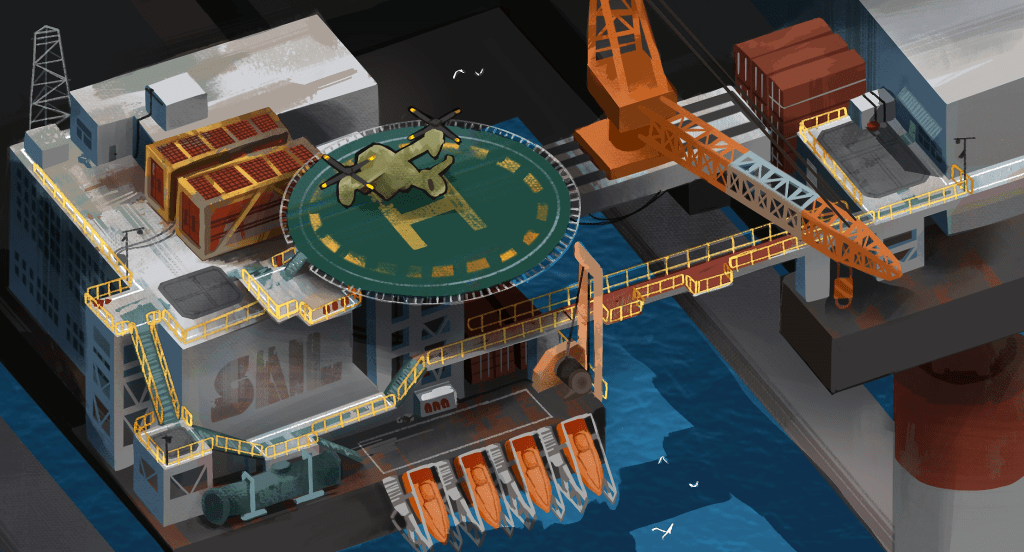
and here’s a concept for an oil rigging platform that our demo and the game’s tutorial level take place on.

Some of our design principles

We’ve set ourselves out to make a game where the combat takes a backseat to dialogue and the hard-to-figure game mechanics are left out. First and foremost we’re making an interactive play. We’re aware that it’s not going to be a game for everybody but we’re okay with that.

Instead of abusing the player’s fight-or-flight response, Paradigm Island focuses on the less talked about and often overlooked tend-and-befriend response. The game offers peaceful solutions for approaching conflicts and this way underlines the importance of communication in terms of solving them. The players aren’t prohibited from solving conflicts violently – or more bluntly put: being a shithead – but are presented with consequences for their hurtfulness. This way the game attempts to make the player reflect on their decisions without shoving anything down their throat. In other words: if you’re looking for a power trip, this game might not be for you. All this being said; it’s not going to be a cozy feel-good game if you somehow got that impression.

Where are we at right now? What next?

We’re constructing a vertical slice that showcases the game’s mechanics and art style as well as the style of the dialogue, music, and overall soundscape. The story and the characters are pretty much thought out by now so what’s left to do is to actually make the damn game. Of course, things will change as we go but we feel we’re on the right track. This dev blog is made to document the construction of the game and to make the process transparent as well as to get feedback from people. I’m pretty sure most of us that have done any kind of art, know how alluring it is to polish things forever and how hard is it to release them to the world. This dev blog is somewhat an attempt to get rid of that mindset. We believe that all art deserves to be seen, finished or not.

Lastly

If any of this seemed interesting to you, click the button below to subscribe to our e-mail list so you’ll get a heads-up whenever there’s a new blog post or news about the game. I promise I won’t spam your mail box to shit. The goal is to post once a week or so but we’ll see how it goes. Anyway; if you made it here I sincerely thank you for your interest and I hope to see you around! Any kind of feedback would mean the world to us and that being said, you can leave a comment under this post or send it directly to oskar.riekko@paradigmisland.blog