
If you were to make a video game consisting mostly of dialogue, you’d be smart to make sure it’s interesting, right? I think so too. Now; how to make it interesting is somewhat of a more complicated question, a question some folks have spent their lifetimes trying to come up with an answer for. Fortunately for you and me, some of those folks have written down what they’ve come up with, and what’s best: some of it is free on the internet. How to make dialogue interesting is one thing, but how to make it interesting and make it make sense in a branching narrative, in a way that leaves you with a coherent story, is another. I’ve gone through the internets and gathered some things I think are worthy of putting down. I’ll add some thoughts of my own into the mix as well.
Straight off the bat: saying everything there is to say about branching video game dialogue is not what I’m trying to accomplish in this post. There’s whole blog series about the subject—among all the other stuff—out there. However, this is a game dev blog about all things having to do with the deving of our game and the things we learn while making it, so it’s more of a personal look at the subject and a form of documentation, if you will.
I’ll be going over some of the tricks I’ve found useful when writing Paradigm Island, as well as some of the “rules”—or rather guidelines—that have helped me to stay on track. I’ll also give my personal take on when I think it’s smart to break those rules or forget them altogether. If you’ve looked into the subject, you’ll notice that some of the stuff I’ll say is the most basic shit you’ll ever come across. I think it’s good to go over it anyway, in case someone reading this is new to it. It’s not like I have it nailed down to a tee myself so this is partly me trying to internalize it.
Where to start?
To keep the focus of this post on dialogue, I assume that we’ve got some kind of framework for a story. I’ve used Hero’s Journey, popularized by Joseph Campbell, and Dan Harmon’s adaptation of it, called Story Circle, as well as Save The Cat by Blake Snyder. If you’re not familiar with any of those, they’re frameworks, made for stories that involve a hero who goes on an adventure, goes through a crisis, and comes back changed. Most of our Western “entertainment” revolves around those templates, be it movies, TV, games, or books. I’d like to add that these kinds of templates have been criticized for encouraging writers to rely on writing that is familiar and successful rather than encouraging creativity and originality as well as leading to formulaic storytelling. My humble opinion would be that they’re not so much something to go by but rather something to understand.
“Most of the things I talk about here people do unconsciously anyway.”
For me, what works best is to just write something. Anything really. It’s easier to just write something and come back to it later with a more critical mindset than to plan the living daylight out of it beforehand. As they say; “writing is thinking” and you get ideas as you go. Putting too many restrictions on how the dialogue should be and what it should accomplish is enough to make anyone freeze. We don’t want to get stuck looking at the empty “paper”. It’s art after all we’re making, not science. I once read a quote about music theory going something like: “It’s good for explaining but not so good for creating”. Kurt Cobain didn’t know the names of the chords he was playing, nor did Jimi Hendrix. William Shakespeare didn’t know what a Story circle is. You get the point. I think you can get pretty far by just doing what feels right. Most of the things I talk about here people do unconsciously anyway. Of course, if writing anything at all in the first place is your problem, this mumbo-jumbo won’t do much for you. Where are the tools and rules I promised?
“When the story has characters, all wanting different things, it almost writes itself.”
Well, to come up with an interesting conversation between two characters, it helps tremendously to know what they want. You as the writer of course get to decide what they want, so my advice would be: make them want different things. That’s how you get conflict, and we love that shit, okay? The conflict’s where it’s at. When the story has characters, all wanting different things, it almost writes itself. Almost. For me personally, having all the significant characters put in a menacing diagram like the one below helps. There I list their core desires, core wounds (traumas, regrets), goals and fears, among other things. This way I can sort of check on them if they’re staying in character. Of course, sometimes you get new ideas as you go and then you adapt and change things. Again: it’s not science.

What next?
This far we’ve established that characters should want something. Hooray, right? Not exactly revolutionary. Every game’s full of characters wanting something and having something to give to the player if the player gets them what they want in exchange. That’s fine and great for some purposes but we’re not stopping there. Now that we know what our characters want, we can proceed to figure out what they actually say.
Often in games, the non-player characters tell the player very straightforwardly what they want. However, when we’re going for a more nuanced, real-feeling dialogue, we should consider something called filters. What’s filters, precious? Well, you know when your dad doesn’t want you to go to that art school you so badly want to go to (conflict spotted) but doesn’t say it directly to you? Instead, he might say something like: “I heard the neighbor’s son is making big bucks in the steel factory.” Wha-bam! That’s a filter right there, in the flesh! The subtext here of course being: “You should do something worthwhile instead of going to the art school”. People don’t usually express themselves straightforwardly. It all comes through a filter, figuratively speaking. That’s just the way it is. Sometimes people don’t even know what they want. They say they want that, but really they want this, and even though they want it, that’s not what they really need, and what they really need is not the thing they want. There’s a lot of room to play around there. Sure, some people can be very blunt about their wants and that can make a interesting character too, but that’s hardly ever the case in the real world.
What’s real?
So is realism what we’re going for here? No. Well, sort of. Let’s take a few steps back for clarity’s sake.
What’s a character really? Taking the dictionary character definition, the word means “a person, animal, or being within a story”. I’d like to draw your attention to the last three words. Within a story. What defines a character, is that he or she is in a story. Now back to the real world: people sometimes just agree on things and want the same things. Their conversations are not always full of conflict and drama. Those are people. We are writing characters. People don’t make for excellent characters without a few tweaks, usually. You should absolutely use people as a reference for your characters (please use common sense and human dignity here) like you should look at real buildings before you paint an imaginary one. Realism in art is just often dull. Boring. It doesn’t say much. Sure, there’s a place for that too and it can be impressive, but we want to say something, right? We’re not making a documentary here. We’re writing a story. A documentary game would be really something though.
Are we lost?
So; we want real-feeling dialogue but we’re not aiming for realism. What the hell? Bear with me. Let’s just keep on digging. Sure, we want the dialogue to feel real but at the same time we’re trying to pull a magic trick: we want the dialogue to be in service of the story, and carry it towards a conclusion where the conflict is resolved. That’s a lot to do at once so let’s keep at it.
Now would be a time for another example:
In Paradigm Island – or in one of its dimensions – our protagonist Mike wants to prove his worth as a mercenary to his father figure Roland and the other mercenaries that have raised him. Mike’s core desire is to find his place in the world and this way he wishes to fulfill that desire. At the same time, Mike doesn’t want to hurt anyone. It’s just that when one works as a mercenary, people often get hurt, so there we have the conflict again. Roland – the leader of the mercenaries – lost his loved one long ago to the mercenary lifestyle and doesn’t want something similar happening to Mike. He likes that Mike looks up to him and that he appreciates his opinions but doesn’t want him to follow in his footsteps. Then again he doesn’t want to admit to himself that he misses his lost lover and that the mercenary life’s not that glamorous when one actually lives it. The theme of Paradigm Island is personal growth and coming-of-age, so that’s something to be taken into consideration when its characters have a conversation, as well as their wants, without forgetting the filters. For the conflict to resolve and the story to reach its conclusion, Mike could realize that the mercenary lifestyle is not suitable for him and that Roland will accept him no matter what he chooses to make of himself. Roland on the other hand needs to admit that he should learn to open himself up to be able to live life to its fullest.
In this example, both characters have human and understandable wants but they also serve a theme and a narrative. In the end they both learn something from one another and everything ends nicely. If both just expressed their wants without filters straight away, there wouldn’t really be a story here. The story’s theme is a subject I’ll save for another post.
What if the dialogue still sucks?
That happens. There’s medication for that. When something a character says or does doesn’t feel right, I try to figure out what’s wrong with it by running it through this filter. Sometimes it’s just that I’m tired and haven’t eaten.
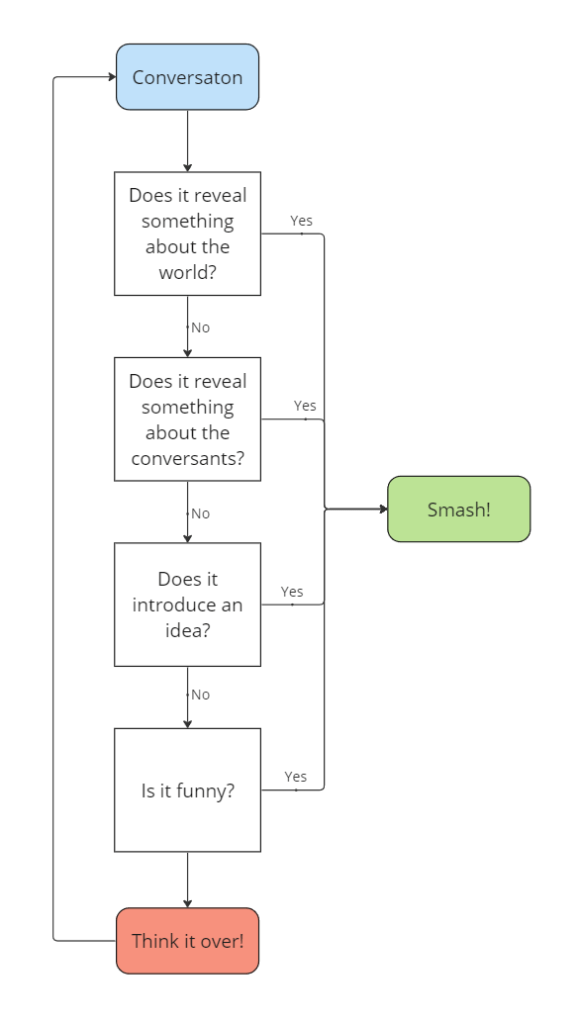
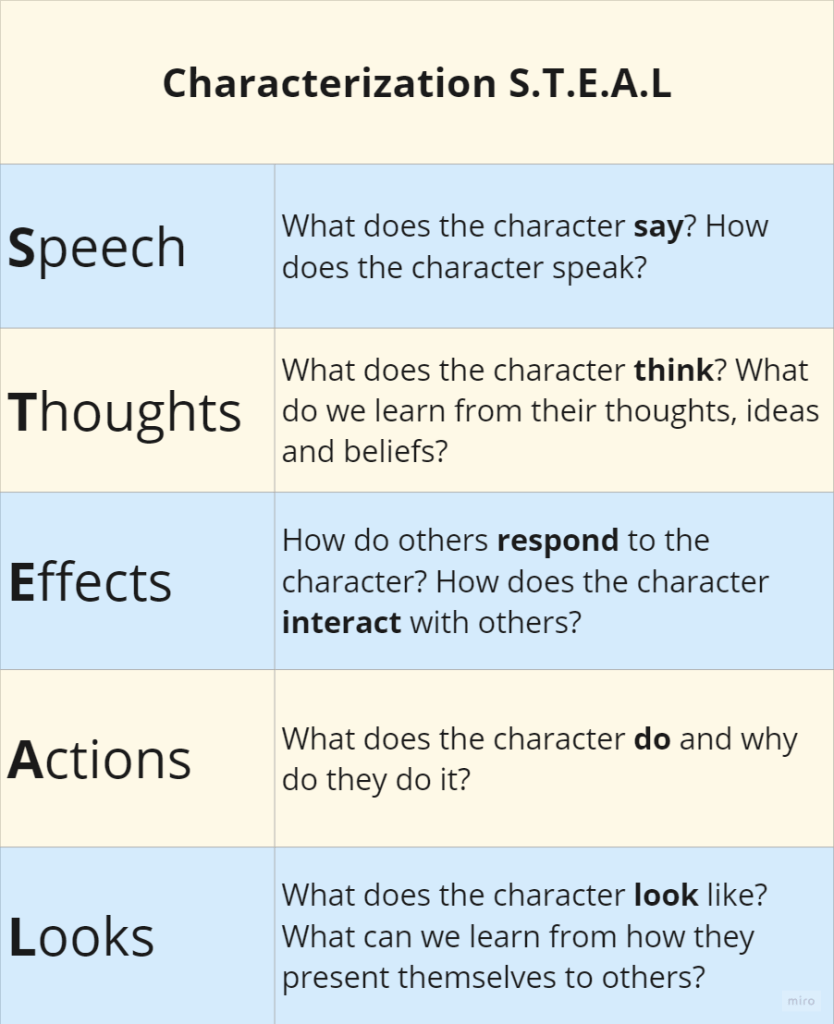
If nothing a character says feels right, do they have to say anything. Saying nothing is also saying something. Maybe they roll their eyes? Maybe they blush? This S.T.E.A.L diagram could also help you out.
Also: time is a good critic. We can step away from the text and then look at it again after some time has passed. We could also read it out loud. Also: if the dialogue feels good, it is good. No need to needlessly complicate it. As with most rules, you should know about them and then forget they exist. Don’t let them hinder your creativity. Only when things are not working should you come back to figure out why. Keep things organic and not too perfect. Perfect is boring. You get perfect out of a machine.
Listen to what people say and how they say it. Why are they saying it and not something else? What mannerisms do they have in their speech, like phrases or words? For example: some upper class, aristocratic character wouldn’t end his or her every sentence in “You know what I’m saying?”, you know what I’m saying?
Let’s go and make the game already!
Now hold your horses! This is a branching narrative, remember? Yeah, I know. Oh golly…
In a branching narrative, the player gets to choose how they want the story to progress, what they’ll ask the non-player characters, and how they relate to what’s being said, with certain limitations of course. How the hell do you make a coherent story and pull resolving character arcs out of that? It’s a sensible question. Is the game destined to be a disoriented, deranged mess?
Not necessarily, though it might come to that if we’re not careful. We’ve got tricks up our sleeve: Knowledge, data and basic human psychology. We as human beings are somewhat change-resistant animals. In other words: we typically don’t like change. Okay, yes, maybe you do, you precious snowflake, but we’re talking generally. This we can use for our advantage. When a player makes certain kinds of choices, he or she usually continues to make those kinds of choices for the rest of the game. If they are playing as a hero they aren’t likely to start playing as a villain all of a sudden, unless given a good reason to. Now this comes with certain challenges too. For the character arc to be satisfying, we want there to be change. A story with the main character starting a certain way and being the same way in the end isn’t a really a memorable one. So how do we make it happen without taking out the player’s autonomy?
“Let’s make the player struggle a bit to remain the character they are role-playing as; to keep things interesting.“
The answer is: reframing. Let’s say the player decides to be a hero and goes around doing virtuous acts. How about if by the time the story has reached its midpoint, it turns out those virtuous acts weren’t so virtuous after all? For the sake of making a point, let’s say that they’ve been fighting rebels for some time, slaughtering them left and right in the name of law and order. Then it turns out the rebels had a good cause to fight against the status quo that the player has been fighting to protect all this time. This way, even if the player keeps acting the same way, the character has changed, now knowing more about the situation. See? Magic! Now the player has to make an informed decision and we get that sweet sweet conflict that we so much desire, not only in the character but in the player too. If the player wants to remain, let’s say, for the sake of an example: a goodie, you should make the story play out so that he or she can’t keep making the same kinds of choices all the way. Let’s make the player struggle a bit to remain the character they are role-playing as; to keep things interesting. The player should also be given dialogue options to express their inner conflict about the fact. Let them speak their mind in the game. That’s immersion baby!
Fun side note I remembered from some interview with the creators of Disco Elysium: If the player kept saying “sorry” a lot in the game, the game took note and made fun of them for being a “sorry cop“. The player data showed that people started playing as total scumbags after the fact. Be careful!
Free will
In a game with multi-branching dialogue, it goes without saying that with it comes the promise of autonomy and freedom of expression. We want to give the player as much freedom as possible but at the same time, we don’t want to lose the story. It’s give and take; you sacrifice some coherency of the story for player autonomy and the other way around. With complete freedom – which in itself is impossible to achieve in a game (maybe in life too, eh?) – it’s impossible to have a balanced story arc. All that being said, we can end up winning on the trade-off if we know what tools to use.
The first trick would be the Illusion of choice. Sometimes it works as well as the real deal. Every decision doesn’t have to change the story as long as the game recognizes those decisions in some way. This, however, is where we want to be mindful; if it’s all bluff with no real effect on the story, the players will pick up on it. They are not stupid after all. Of course, we can’t have every single decision have an effect on the story. It’s a game of balance. We gotta mix it up. Below’s an image to demonstrate the Illusion of choice.

The second trick would be bottlenecks. It means that we can have the story branching somewhat freely for some time but then we guide it back to a single place where it all comes together. From there on, it can start branching again. We can repeat this process as many times as necessary. This way the story doesn’t get exponentially complex as it progresses. Below’s an image to demonstrate a bottleneck.

To keep things simple, I’d start by forgetting choices and bottlenecks for a while and focus on making one linear version of the story that has our hero 1. going on an adventure, 2. getting into a crisis, and 3. coming back changed (the hero’s journey). Once we’re done with that- and I’m not implying that it’s an easy task – we can start thinking: what if the hero acts differently? How can we make a story with those same building blocks out of that? Let’s use our imagination a bit here; what kind of different play styles could the game be completed with? Maybe the player wants to be cool and on top of the situation at all times. Maybe they want to wreak havoc and inflict suffering. Here we’ve got room to insert some of our own values into the mix. If you don’t want there to be bloodshed in the game, we can just exclude that. One example that’s common in games is that you can’t wack children. Fair enough. Of course, we can – and should – also ask the players: “Did the game allow you to play as the character you wanted to be?” Of course, if the answer is always “No. I wanted bloodshed”, we must think over why is that. Let’s not get too crazy about how many different play styles the game can be run through with. Not yet anyway. For starters, and for the sake of the argument, we’ll go with three very simple ones: you can be good, evil, or chaotic.
“The thing about us human beings – other than that we’re change-resistant – is that we are pattern-seeking.”
Now; how would you go about making dialogue based on these three potential play styles we just came up with? One thing I’d keep a close eye on would be that whenever the player is chatting someone up, they’re presented with dialogue options that let them be one of those “playable characters”, meaning in this example: good, evil, or chaotic. However, if that’s the only rule we follow, the game will be ass.
The thing about us human beings – other than that we’re change-resistant – is that we are pattern-seeking. If it’s too easy for the player pick up what you as the game maker are up to, they’ll start thinking that you take them for an idiot, and we don’t want that. Here reframing comes handy again; we can make it so that as the player gains information of the world, the choices they make are shown in a new light. Knowing that someone has a phobia of water makes you reconsider inviting that someone swimming and then continuing to tease them if they refuse, right? Let’s keep the player guessing.
How to actually make the dialog in the game
For the making of Paradigm Island, we’re using Dialogue System for Unity from the Unity asset store. It has proven to be an excellent tool and made it possible for me to work on the game without actually knowing any coding. It makes it easy to make conditions like: “If character A said this, then a dialogue option with character B can be accessed”. Below is a screenshot of how an actual conversation with an NPC would look in the Unity game engine. It’s intentionally blurry to not spoil the content.

Final thoughts
In Paradigm Island, we are still exploring how much we actually want the player to be able to affect the plot. At its core—and its theme being personal growth—it’s a game focusing more on the inner conflict than the outer. It’s not like we’re making a sandbox game either. Telling a gripping, emotional story is our main priority. Freedom of self-expression – while still being important – is second. Maybe rather than giving the player a hammer to mold the story to their liking, we could let them choose a lens which they see it through. The world can seem to be full of dangers or full opportunities, depending on what the person looking at it has gone through. Maybe we can use that to our advantage in the game. It all comes back to reframing.
I merely scratched the surface here and there’s still much I’d like to talk about considering this subject. However: to not make this post absurdly long I’ll save the rest of it for the next post.
Would you like to follow the creation of Paradigm Island?
By clicking the button below, you can subscribe to our mailing list. That way you’ll get a heads-up whenever there’s a new blog post or other news about the game. I’m planning on publishing a new blog post every week or so. If you have any comments on what you would like to know about or any feedback we’d love to hear about it! You can leave comment or feedback below or email it to me at oskar.riekko@paradigmisland.blog.
Further reading:
Blog series about branching dialogue systems
How to resolve the tension between story and interaction
Developing Meaningful Player Character Arcs in Branching Narrative
 Paradigm Island